Industry updates · 14 October 2026 · 4 min read
Does Anthropic’s new usage policy change anything for your business?
Anthropic has updated the rules for what Claude may be used for. Here is what actually changes, the 3 parts an everyday business should check, and what to do before the new version takes effect.

Does Anthropic’s new usage policy change anything for your business? For most everyday use, we expect very little. Anthropic published the update on 8 October 2026, it takes effect on 12 November, and the company says most of the changes “are intended to clarify existing rules”1.
A usage policy is the set of rules for what a tool may be used for. It applies whether you use Claude directly or through a product that has Claude built in2, so a short check is worth it. This is general guidance, not legal advice.
What actually changes on 12 November 2026?
Mostly wording. Rules that sat in several places have been gathered and made more explicit, with a few additions for newer ways of using Claude.
From Anthropic’s own summary1:
- Deception has its own section. Rules against fake accounts and fabricated news sites used to be spread across several sections. They now sit together and apply “whether political or commercial”.
- High-risk uses: same rules, clearer list. Where AI affects someone’s health, legal rights, finances, livelihood or access to essential services, a qualified person must be able to review and change its recommendation (a human in the loop), and the person affected must be told AI was used. Anthropic says these requirements “haven’t changed”. The section now lists what is covered and what is not.
- New: AI connected to machinery. Where Claude drives hardware that could injure someone, an operator must be able to watch it and stop it, and the equipment must hold a safe state if the connection drops.
- New: no sustained abuse of the model. It is meant for “extreme cases” only, not for ordinary frustration, pushback or testing.
- Weapons and surveillance: clearer wording. Anthropic says this “does not reflect a change in what we enforce in practice”.
Which everyday uses should you check?
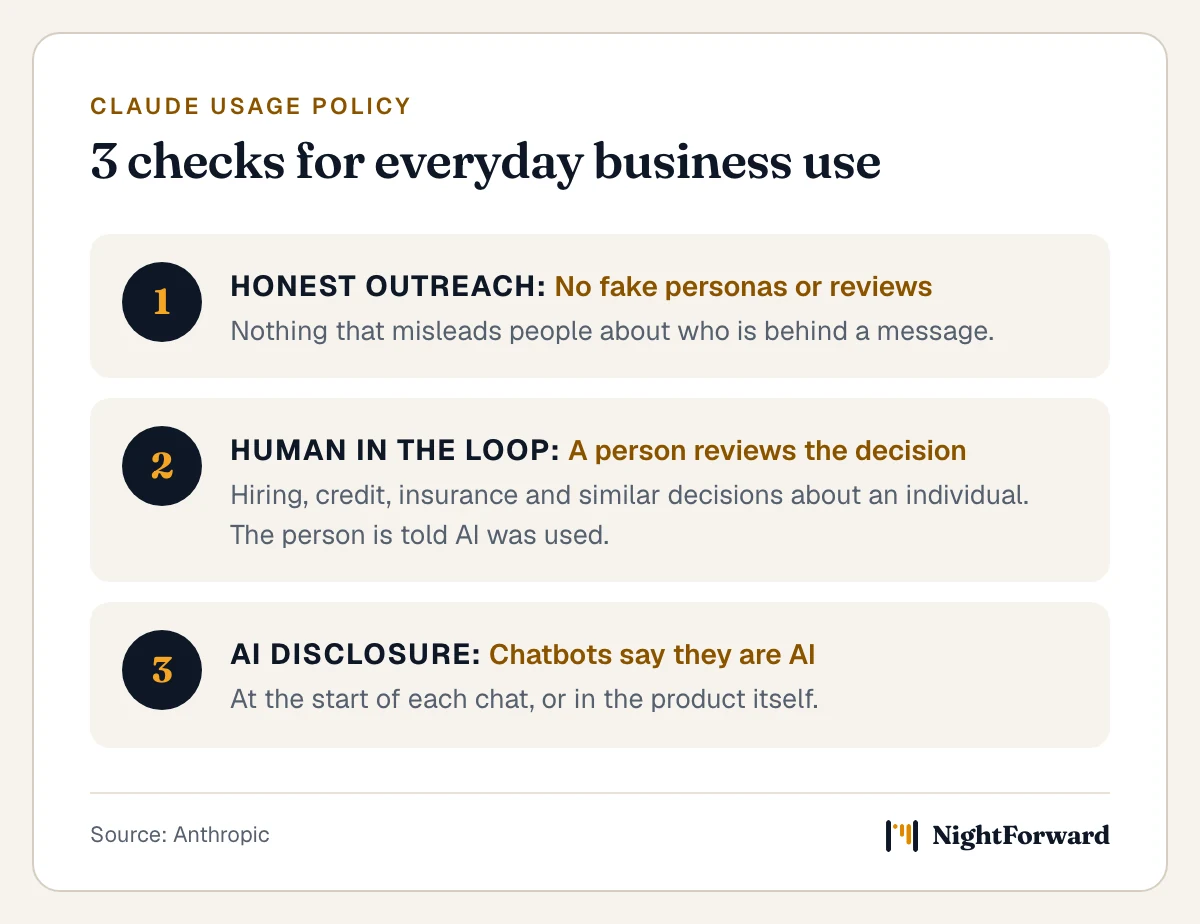
3: marketing and outreach, decisions about individual people, and any chatbot or agent that deals with customers.
This is how the policy reads from 12 November2. Anthropic’s summary does not present these 3 as new, but they are now easier to find.
- Outreach must not pretend. The policy rules out fake personas and accounts that mislead people about who is behind a message, and it names “sockpuppets, astroturfing, fake reviews, or bots that claim to be human”. Our reading: AI-drafted marketing sent openly in your own name is not the target.
- Decisions about a person need a qualified person. Hiring is on the list: “screening, ranking, advancing, or rejecting candidates”. So are credit, insurance and housing decisions. A qualified person must review the AI’s recommendation before it is used, and the individual must be told that AI was used. Internal drafting, research and analysis are not covered, and neither are business operations that don’t decide about a specific individual.
- A chatbot that talks to customers must say it is AI. Customers must be told they are “interacting with AI rather than a human”, at least at the start of each chat or in the product itself.
If you run AI agents, 1 more line matters: users are responsible for the agents they build or deploy, including what those agents do through tools, browsers and connected systems2. We covered what that takes in Can AI agents go rogue?
What should you do before 12 November 2026?
Go through the 3 areas, and fix anything that depends on pretending to be a person or on an unreviewed decision about someone.
- Outreach: check that no campaign uses invented personas, invented reviews or accounts posing as independent voices.
- Decisions about people: if AI helps screen job candidates or assess customers, make sure a qualified person reviews each recommendation and the people affected are told.
- Chatbots: check that yours says it is AI at the start. The assistant on our own website introduces itself as an AI assistant in its first message.
- Suppliers: if someone runs Claude-based tools for you, ask them the same 3 questions.
Local law still comes first: for high-risk uses, the policy says to follow it wherever it conflicts or asks for more2. And the policy can be enforced. For a suspected violation, Anthropic says it may warn a user, or throttle, limit, suspend or end their access2.
Get new updates
Articles, news and offers from NightForward.
Researched and drafted with AI tools, fact-checked against the sources below, and edited by Kringle Lam.