AI & Automation · 3 October 2026 · 7 min read
Is everyone using AI except you? Not yet, but that’s your last window
Official statistics show most businesses haven’t adopted AI yet, so ignore the hype. But don’t relax: the businesses getting results from AI are pulling away, and the gap widens every year. Here’s what the numbers say.

If you read the AI headlines, you’d think every business is already running on AI and you’re the last to arrive. So is everyone using AI except you? No. Official statistics, the kind governments collect from thousands of businesses, show about one business in five using AI.
That’s worth knowing, because it means you can ignore the hype. But it isn’t a reason to relax. The same data shows something more important: the businesses using AI well are pulling away from everyone else, and the gap is widening every year. Calm about the hype, yes. Relaxed about the gap, no.
This is the second part of our series on cutting through the AI noise. Last time we looked at why the newest AI model rarely matters. This time: who is actually using AI, and why waiting is getting more expensive.
How many businesses actually use AI?
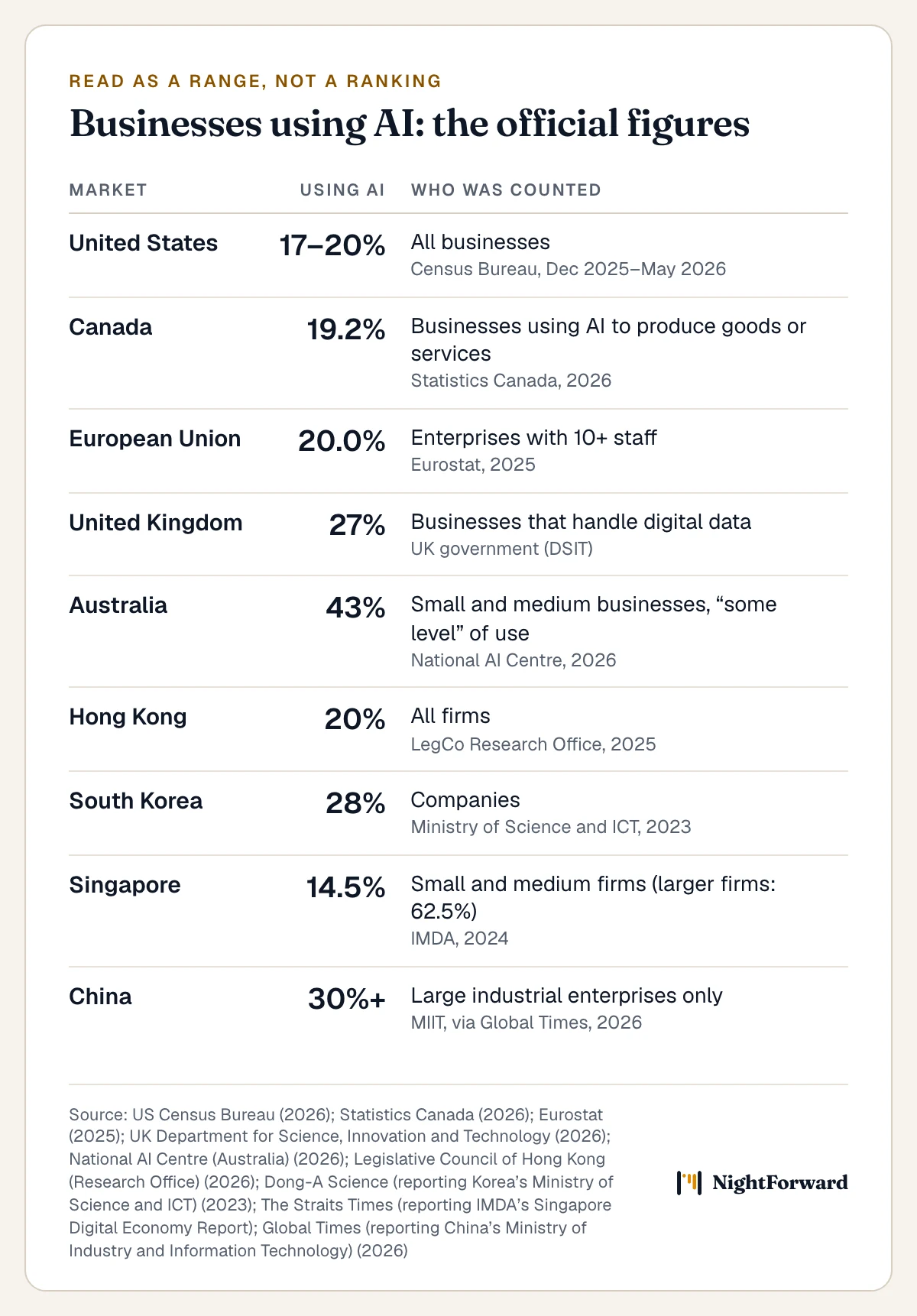
Around one in five in the US, Canada and the EU, by their official statistics. The US Census Bureau found business AI use hovered between 17% and 20% from December 2025 to May 20261. Statistics Canada put it at 19.2% in the second quarter of 20262. Across the EU, 20.0% of enterprises with 10 or more employees used AI in 20253.
Elsewhere, the official figures count different groups. In the UK, 27% of businesses that handle digital data use AI-based technologies4. In Australia, 43% of small and medium businesses report “some level” of AI adoption5. In Hong Kong, the share of firms using AI rose from 7% in 2021 to 20% in 20256. South Korea’s government survey found 28% of companies using AI, though back in 20237. And in China, the Ministry of Industry and Information Technology says AI adoption among large industrial enterprises has passed 30%8, a figure that covers only big manufacturers.
The OECD warns that cross-country comparisons “should be made with great caution” because surveys define and measure AI use differently9. So read the table below as a range, not a league table.
Why do some surveys say most businesses already use AI?
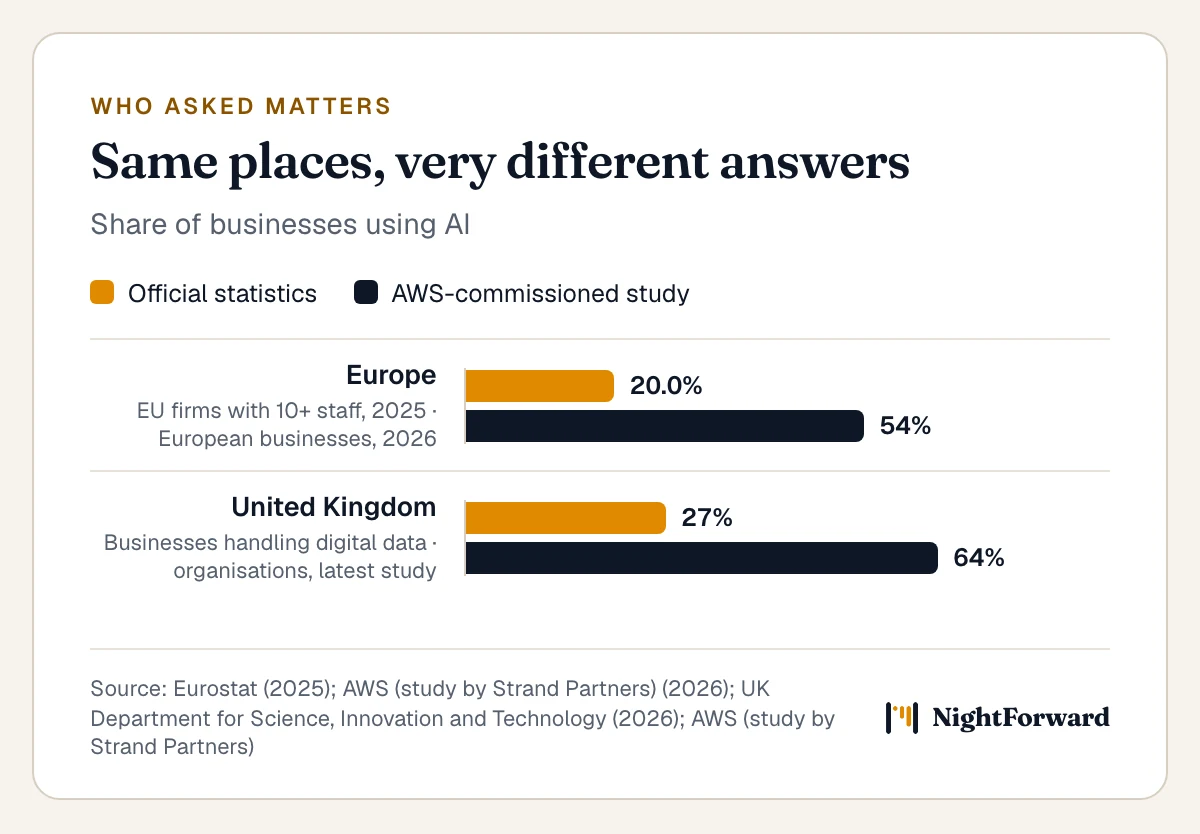
Because they ask different questions, sometimes on behalf of companies that sell AI. Europe and the UK show it clearly. Eurostat, the EU’s official statistics office, found 20.0% of EU enterprises used AI in 20253, while a study commissioned by Amazon Web Services (AWS) reported that 54% of European businesses use AI11. In the UK, the government’s figure is 27% of businesses that handle digital data4, while AWS’s latest UK study reports 64% of organisations12.
Neither is necessarily wrong. We don’t know every detail of how each survey was run, but the gap shows how much the question matters: counting any use of an AI tool gives a far higher figure than asking whether AI is part of how the business works. Before trusting a headline figure, ask who was asked, what counted as “using AI” and who paid for the survey.
How fast is AI adoption growing?
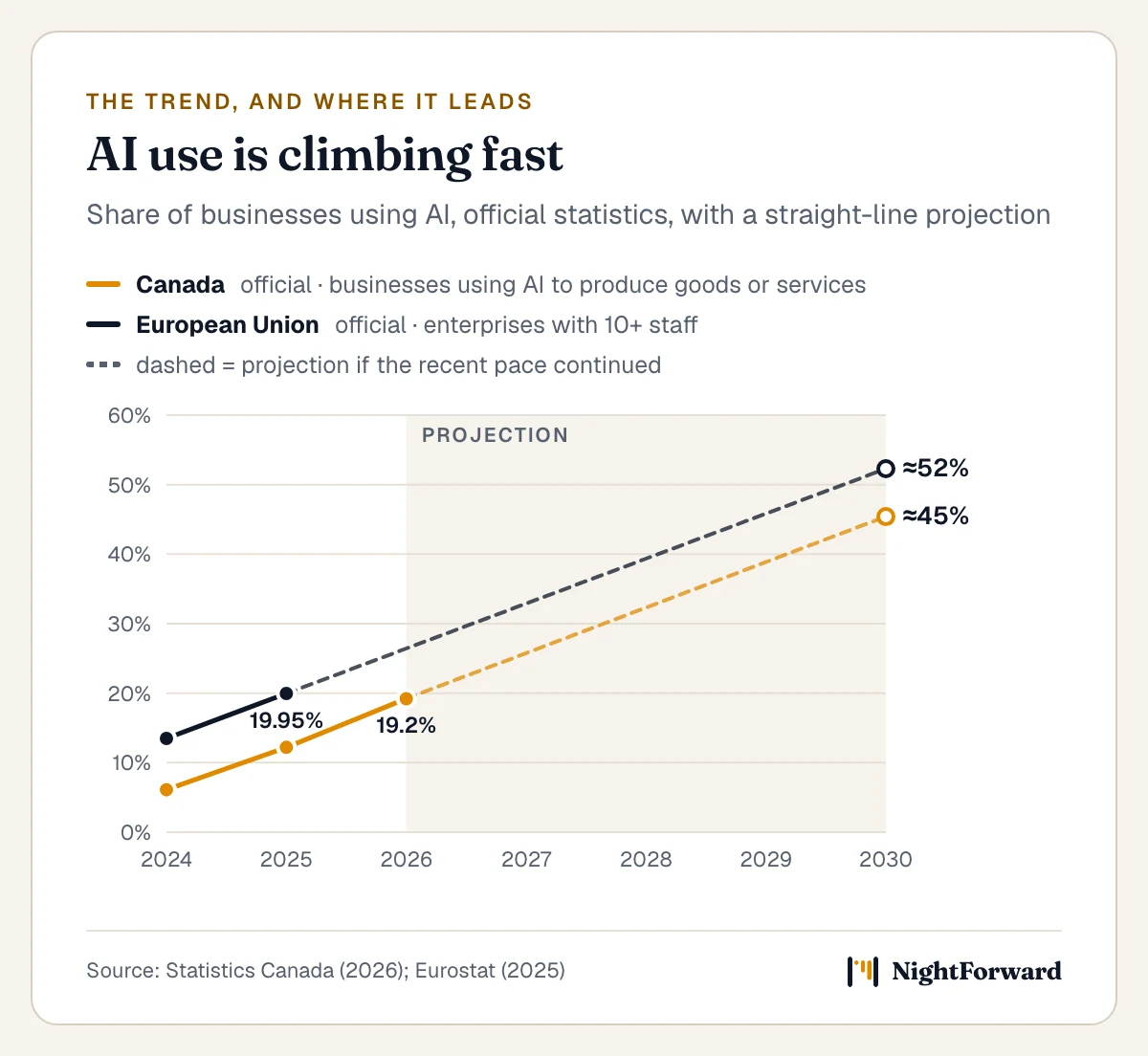
Fast. In Canada, the share of businesses using AI went from 6.1% in 2024 to 12.2% in 2025 and 19.2% in 20262. In the EU, it rose by 6.47 percentage points in a single year, to 19.95% in 202513. Commissioned studies point the same way: AWS’s European figure went from 33% to 54% in two years11.
To make that concrete, we extended each official trend in a straight line. If Canada and the EU simply kept their recent pace, around half of EU businesses, and well over a third of Canadian ones, would be using AI by 2030. That’s an illustration, not a forecast: real adoption usually speeds up and then levels off. But it shows how much will change within five years, and how quickly “most businesses haven’t started” stops being true.
How many small businesses use AI, and are they falling behind?
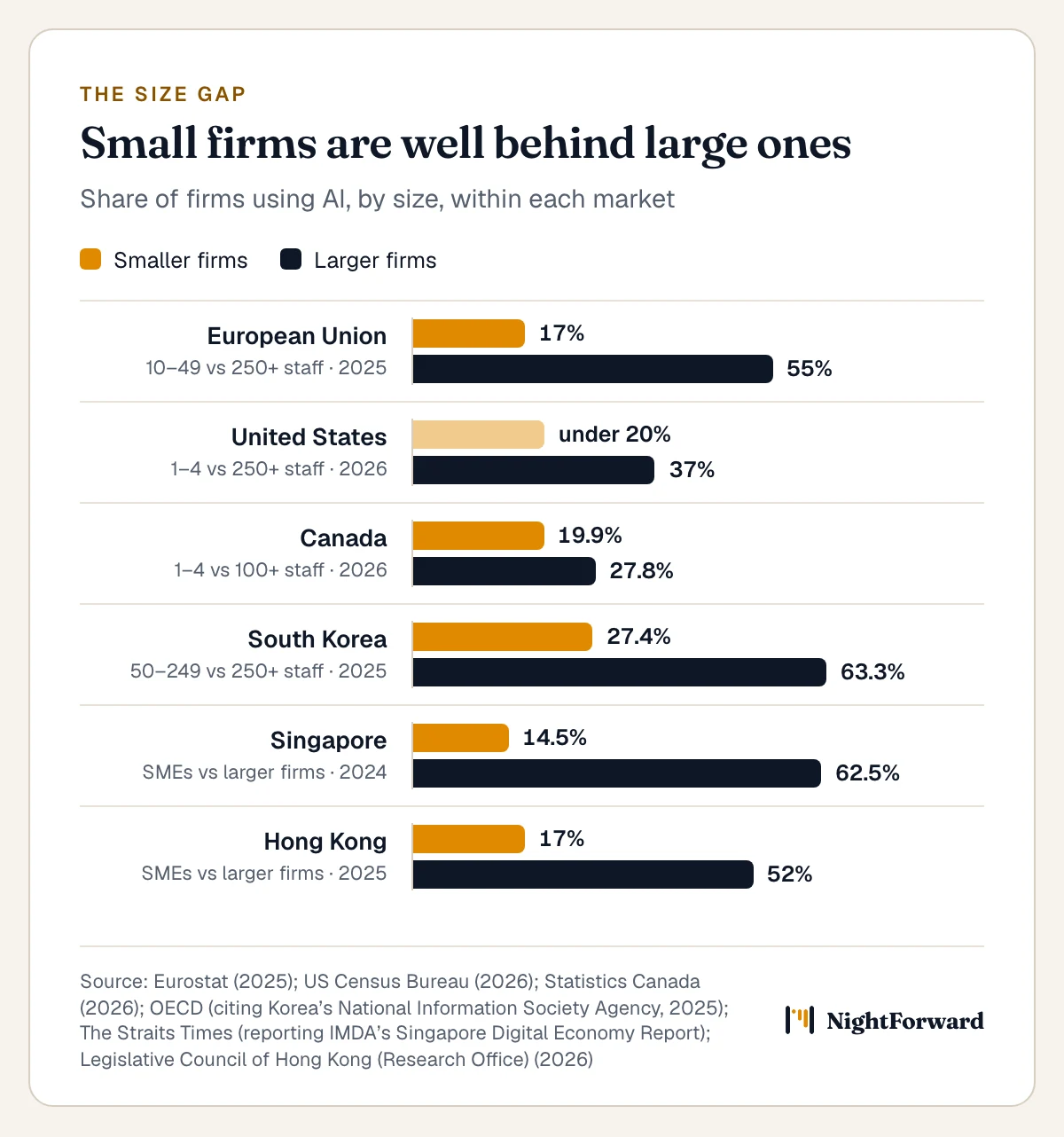
Fewer than large ones, and often far fewer, in every market we found that reports it by size. In the EU, 17% of small enterprises used AI in 2025, against 55% of large ones13. In the US, 37% of firms with at least 250 employees use AI, while less than 20% of firms with four or fewer do1. Canada’s gap is narrower: 19.9% of businesses with one to four employees against 27.8% of those with 100 or more2. In South Korea it’s 27.4% of firms with 50 to 249 employees against 63.3% of those with more than 25014; in Singapore, 14.5% of smaller firms against 62.5% of larger ones10; and in Hong Kong, 17% against 52%6. Across the OECD as a whole, large firms are more than three times as likely to use AI as small ones9. The UK and China figures we found don’t split out small firms, so they’re not in the chart.
And the gap isn’t standing still. In the US, AI use grew among firms with at least 20 employees but didn’t change significantly among smaller ones1. In Singapore, smaller firms gained about ten percentage points in a year while larger ones gained nearly twenty, from 44% to 62.5%10.
Why does the gap keep widening?
Because the businesses using AI well keep compounding their advantage. In Britain, the statistics office found that businesses using advanced digital technologies such as AI and cloud computing achieved around 19% higher turnover per worker, even after accounting for management practices and other differences4. In the US, Census researchers found a robust positive correlation between firms’ commercial performance and how broadly they use AI15.
The leaders are also speeding up. McKinsey’s AI “high performers” (the roughly 6% of companies that attribute at least 5% of their operating profit to AI) are changing how they work faster than everyone else: nearly three-quarters now fundamentally redesign workflows around AI, up from 55% a year earlier, while just one-quarter of other companies do16. Size compounds too. In the US, firms with 1,000 or more employees grew their share of employment from 37.6% in 2000 to 42.3% in 2025, and economists at the Peterson Institute think “further concentration seems likely from future AI adoption”17. The OECD warns that divides between leading and other firms “may widen”9.
So can small businesses afford to wait?
No. You’re not late yet, but every year you wait makes catching up harder. The Peterson Institute’s economists put it plainly: “faster adopters are likely to gain competitive advantages over their slower rivals”17.
Our view: each year a competitor runs on AI, it gets a little more efficient, wins a few more customers and learns more about what works. Those gains compound. Waiting doesn’t keep you level; it lets the gap grow, and catching up later means chasing a moving target with thinner margins and fewer customers to fund the effort. The good news is that in most markets the majority hasn’t moved yet. That’s your last window to move early. Start small, measure it, and start now.
Are people ahead of businesses?
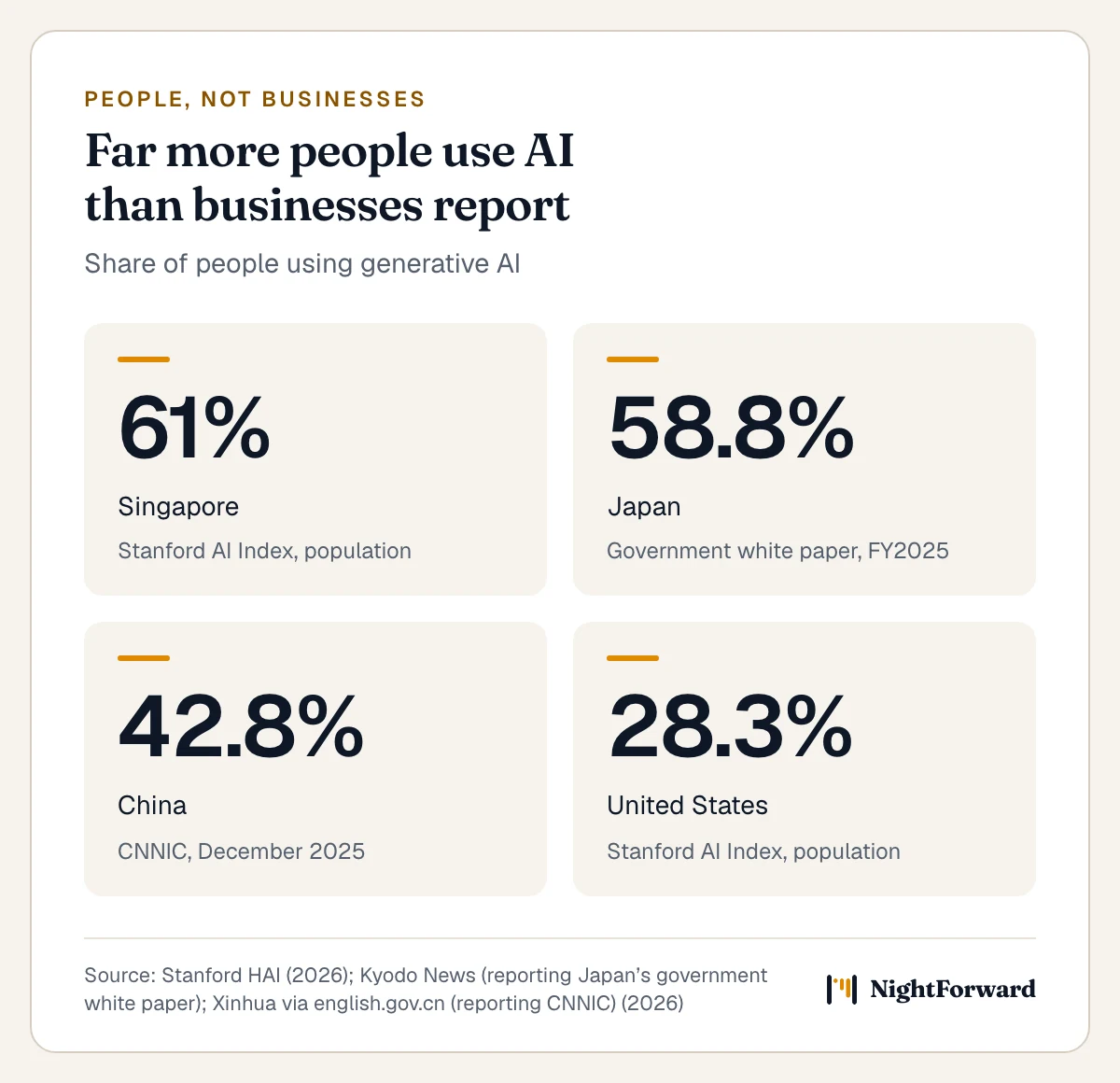
Yes, and that raises the stakes. Stanford’s AI Index puts generative AI use at 61% of the population in Singapore and 28.3% in the US18. Japan’s government white paper found 58.8% of people had used generative AI in fiscal 202519, and in China the adoption rate among people reached 42.8% by December 202520. These figures count people, not companies, and come from different surveys, so they can’t be compared exactly with the business figures. But the pattern is hard to miss: your staff and your customers are getting used to AI, whether or not your business has a plan for it.
Why do some businesses hold back?
In Canada and Australia, mostly relevance and trust. In Canada, 41.4% of businesses with one to four employees say AI isn’t relevant to them, against 21.3% of businesses with 100 or more employees2. In Australia, 54% of small and medium businesses that don’t use AI say it isn’t relevant, and around 65% cite distrust of AI decision-making or a preference to keep human control5.
Both are answerable. On trust: keep a person in charge of anything that reaches a customer. In the US, 66% of businesses using AI use it only to help people with tasks15, and only 2% reported AI-related job cuts15. On relevance: start with one task where AI would move a number you already track. That’s the subject of our next issue: how to put a number on an AI project.
Researched and drafted with AI tools, fact-checked against the sources below, and edited by Kringle L.
Sources
- US Census Bureau, Large Firms With at Least 20 Employees Biggest AI Users (opens in a new tab) (May 2026)
- Statistics Canada, Analysis on artificial intelligence use by businesses in Canada, second quarter of 2026 (opens in a new tab) (11 June 2026)
- Eurostat, 20% of EU enterprises use AI technologies (opens in a new tab) (11 December 2025)
- UK Department for Science, Innovation and Technology, Business data use and productivity study (wave 2): statistical report (opens in a new tab) (28 January 2026)
- National AI Centre (Australia), AI adoption insights: December 2025 to February 2026 (opens in a new tab) (2026)
- Legislative Council of Hong Kong (Research Office), Empowering businesses through artificial intelligence (opens in a new tab) (16 July 2026)
- Dong-A Science (reporting Korea’s Ministry of Science and ICT), 28% of South Korean Companies Adopt AI (opens in a new tab) (28 December 2023)
- Global Times (reporting China’s Ministry of Industry and Information Technology), More than 30% of China’s large industrial enterprises have adopted AI: official (opens in a new tab) (7 July 2026)
- OECD, AI adoption by small and medium-sized enterprises (opens in a new tab) (9 December 2025)
- The Straits Times (reporting IMDA’s Singapore Digital Economy Report), Singapore’s digital economy contributed 18.6% to GDP (opens in a new tab)
- AWS (study by Strand Partners), Majority of European businesses now use AI, but startups signal early warning on scaling challenges (opens in a new tab) (18 March 2026)
- AWS (study by Strand Partners), New AWS report reveals that nearly two-thirds of UK organisations now use AI (opens in a new tab)
- Eurostat, Use of artificial intelligence in enterprises (Statistics Explained) (opens in a new tab) (December 2025)
- OECD (citing Korea’s National Information Society Agency, 2025), Artificial Intelligence and the Labour Market in Korea (opens in a new tab)
- US Census Bureau, The Microstructure of AI Diffusion: Evidence from Firms, Business Functions and Workers (working paper) (opens in a new tab) (7 May 2026)
- McKinsey & Company, The state of AI in 2026: On the road to ROI (opens in a new tab) (25 August 2026)
- Peterson Institute for International Economics, The adoption of AI by industrial sectors (opens in a new tab) (12 March 2026)
- Stanford HAI, The 2026 AI Index Report (opens in a new tab) (13 April 2026)
- Kyodo News (reporting Japan’s government white paper), Generative AI use in Japan doubles in FY 2025 (opens in a new tab)
- Xinhua via english.gov.cn (reporting CNNIC), China’s internet user base hits 1.125 billion as AI adoption surges (opens in a new tab) (5 February 2026)