AI & Automation · 13 min read
Your brand at risk? 57% of consumers would let an AI shopping agent switch brands for better value
Published · Updated
AI assistants already send a fast-growing stream of shoppers to retail sites, but they rarely pay for anything yet. Here are the main numbers in one place, what the 2030 forecasts say, why they disagree, and what to do now.
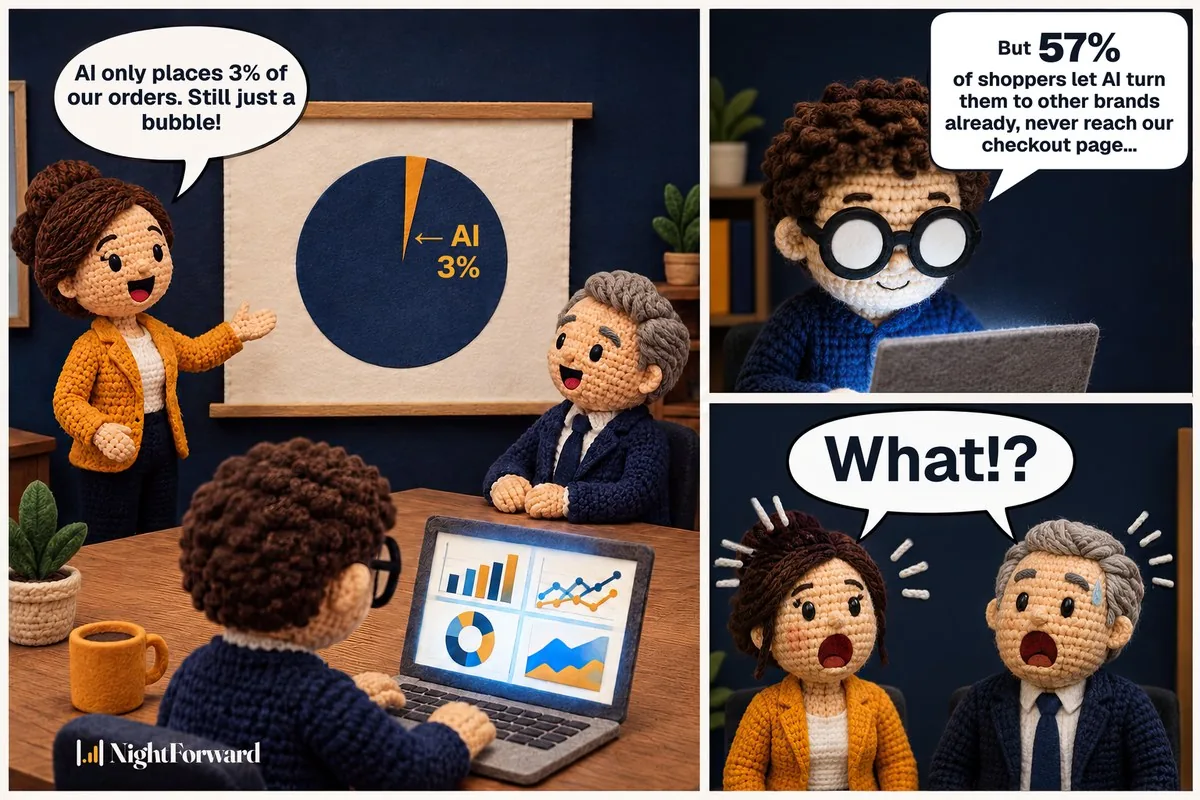
More and more shoppers ask an AI assistant before they ever open a shop’s website. The assistant compares, shortlists and sends them on, and in a growing number of cases it is starting to buy for them.
This piece puts the main numbers in one place: how fast AI traffic to retail sites is growing, how much buying AI agents really do today, what the big forecasts say for 2030, and what shoppers need before they hand over their card. Each number comes with its source and date, because the sources often measure quite different things.
The short version: the shift starts with finding products, not paying for them. And the finding part is already here.
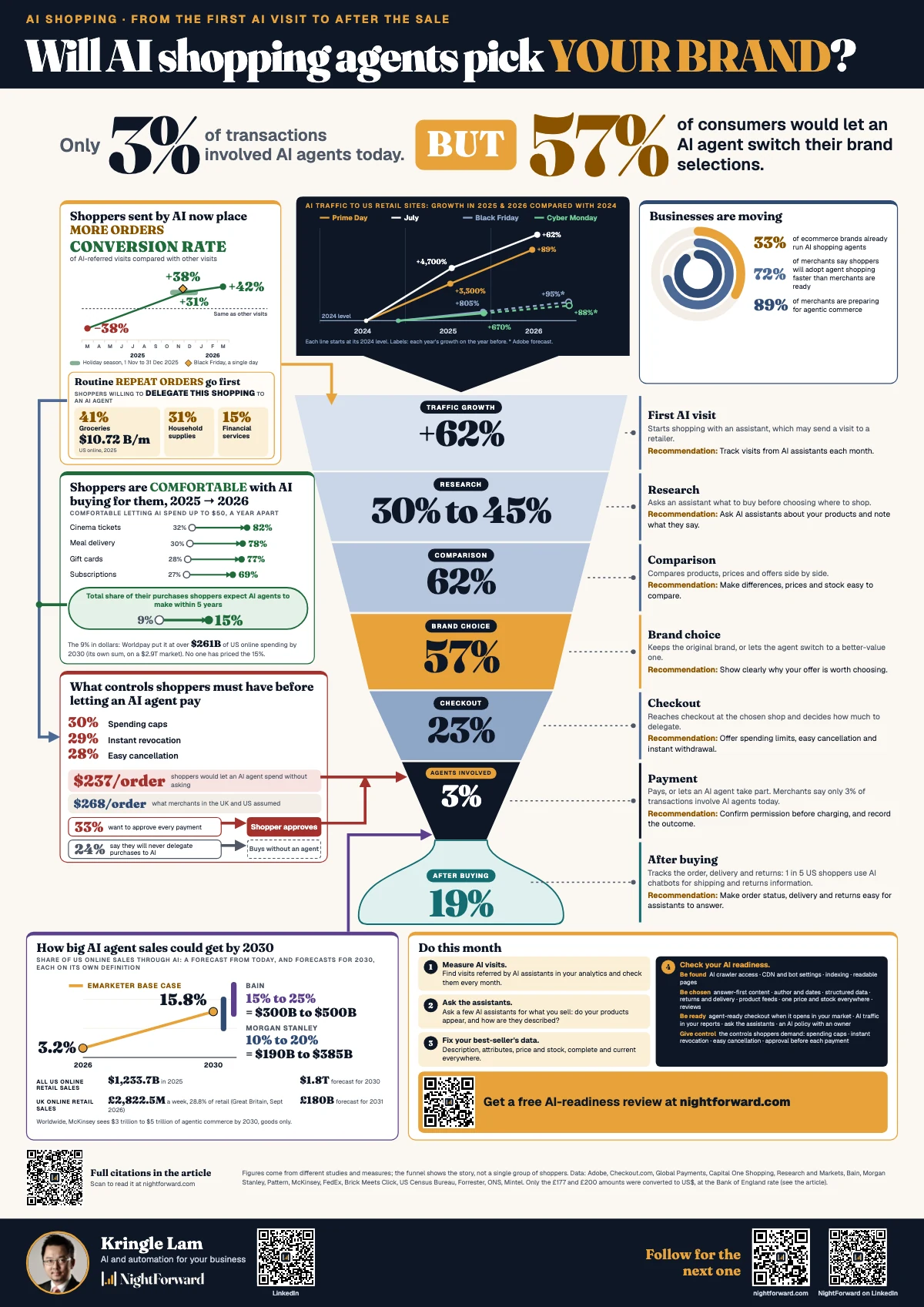
Prefer the whole story on 1 page? The poster at the end puts every number from this piece together, from the first AI visit to after the sale.
How fast is AI shopping traffic growing?
Very fast, from a small start. In July 2025, generative AI referral traffic to US retail sites rose as much as 4,700% year on year, while organic search traffic fell.
That figure comes from a Research and Markets report, summarised in its press release1. Adobe, which counts shoppers clicking a link from an AI service to a retail site, saw the same story through the holidays. On Cyber Monday 2024, chatbot traffic to retail sites rose 1,950%2. In 2025, AI traffic rose 805% on Black Friday, as cited by Paz.ai3, 670% on Cyber Monday4 and 693% over November and December5. For the 2026 holiday season, Adobe expects a rise of 130%, with Black Friday up 95% and Cyber Monday up 88%6.
The visits are now worth more than other visits. In March 2025, AI traffic converted 38% worse than other traffic7. Over the 2025 holiday season, AI referrals converted 31% more than non-AI sources, and 38% more on Black Friday5. By March 2026, AI traffic converted 42% better7. Adobe publishes the gap, not the conversion rates themselves, so we can’t say what share of visits ends in a sale.
A caution before the big numbers run away with us: a percentage rise on a small base can still mean a modest number of visits. None of the pages we read gives AI’s share of all retail traffic.
Is the growth slowing down?
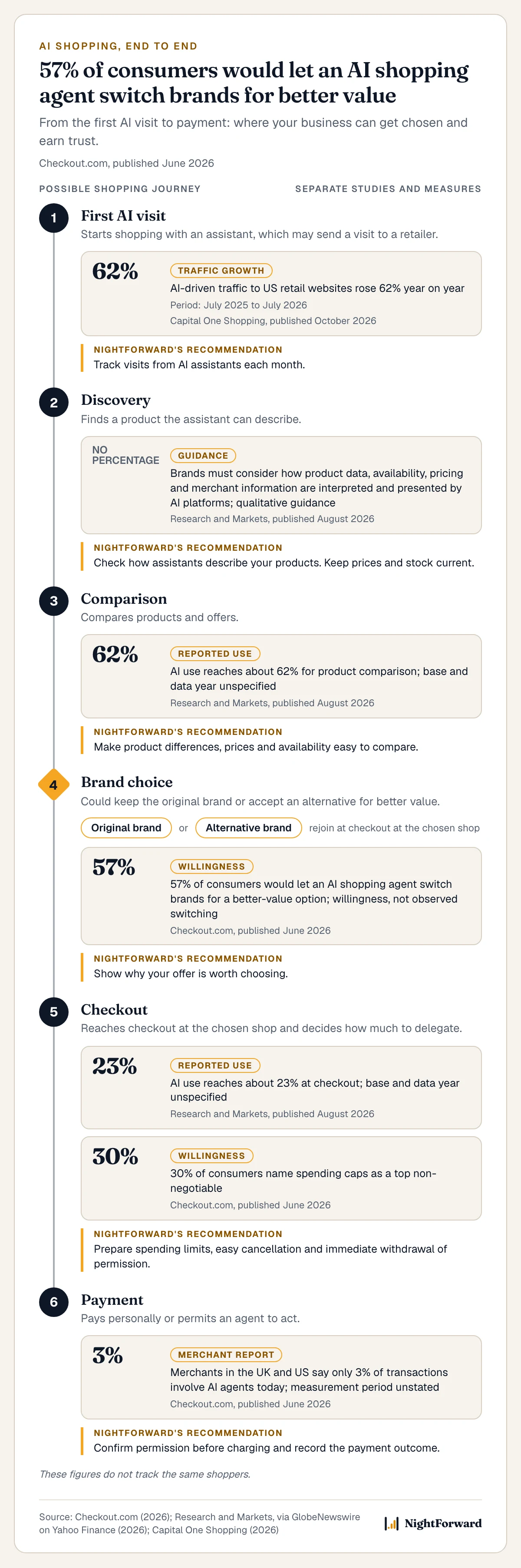
The growth rate is, the traffic isn’t. Rates fell from thousands of percent in 2025 to double digits in 2026, which is what you would expect as the base gets bigger.
Take the same shopping event a year apart. During Prime Day 2025, in July, generative AI traffic to US retail sites rose 3,300%, Adobe found10. During Prime Day 2026, held in June, AI traffic rose 89% year on year11. Across the full year from July 2025 to July 2026, AI-driven traffic to US retail websites rose 62%9.
We read this as a channel settling in, not fading: 89% growth on top of a year that saw a 3,300% jump still means many more visits than before.
2 cautions. Adobe counts shoppers clicking on a link from an AI service, so a visit is not a sale4. And the 2 Prime Days fell in different weeks of the year. Treat them as signs of direction, not as 1 measured series.
Are AI agents actually buying for shoppers yet?
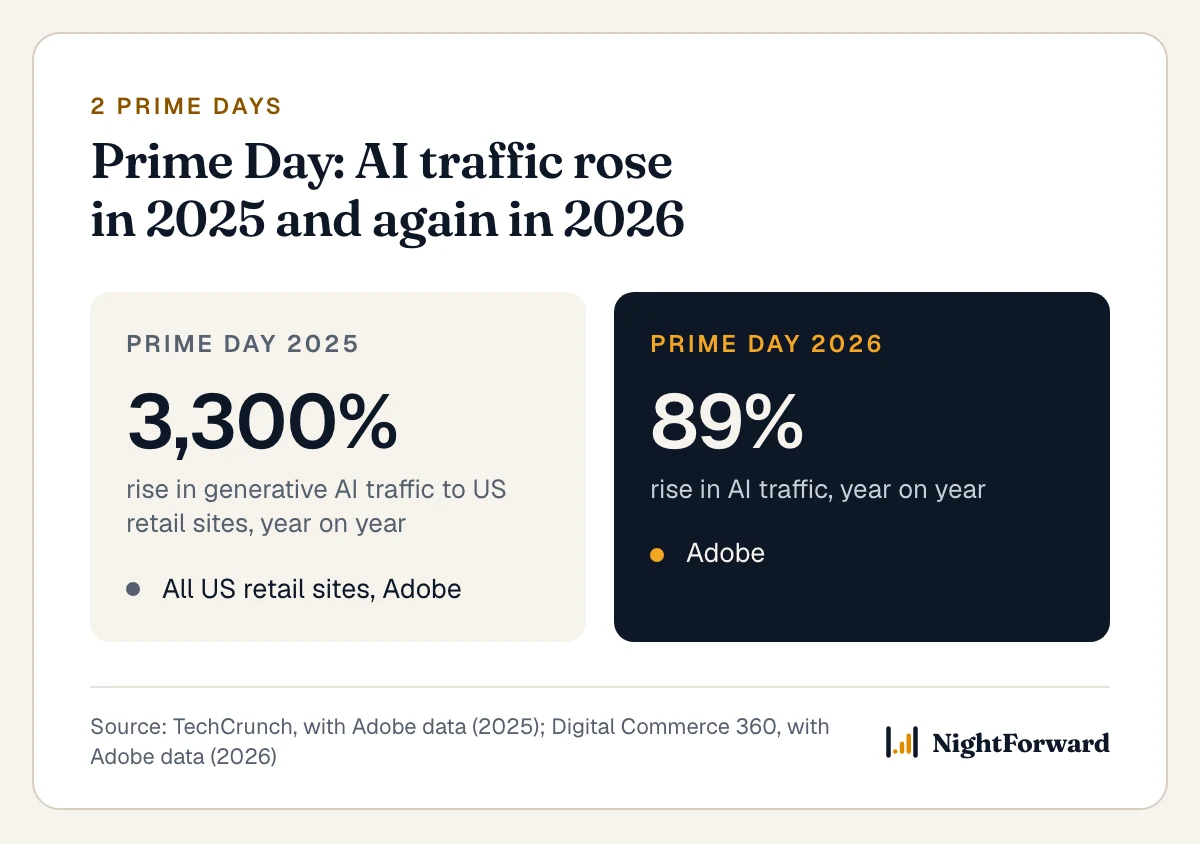
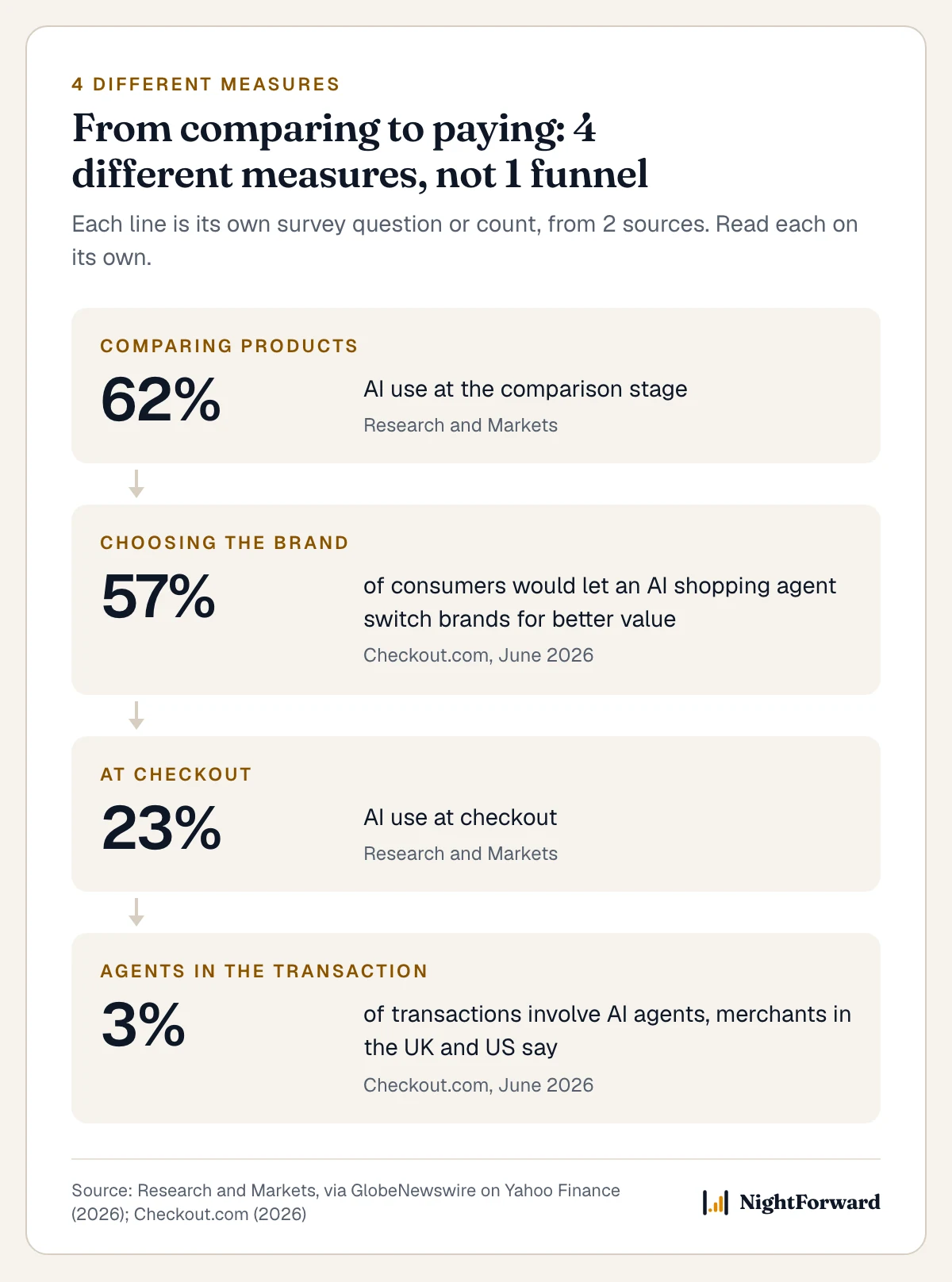
Rarely. AI is used most when shoppers compare, much less at checkout, and merchants in the UK and US say only 3% of transactions involve AI agents today.
The Research and Markets report puts AI use at about 62% for product comparison, about 23% at checkout and 19% after the purchase1. Its press release does not say who was counted, or what “after the purchase” covers. Other surveys fill part of the gap: in a FedEx survey of US consumers in December 2025, 1 in 5 used AI chatbots to find information about shipping and returns, and 53% of those who used AI customer service during a return found it more satisfying than a human agent12. Checkout.com’s research from June 2026 gives the 3% figure, as reported by merchants8.
Bain sees the same split in the US. It estimates 30% to 45% of US consumers use generative AI to research or compare products before buying, while most consumers are “not yet comfortable” letting AI handle a whole purchase without a person involved13. Morgan Stanley’s AlphaWise survey found that nearly 23% of Americans made at least 1 AI-assisted purchase in the past month14. “AI-assisted” is a much looser idea than an agent completing the checkout.
Even the platforms are adjusting. According to Paz.ai, OpenAI deprecated ChatGPT Instant Checkout in March 2026, moving to discovery in the chat and buying on the merchant’s own site3.
How big could AI shopping be by 2030?
Big, but nobody agrees how big. US estimates run from $190 billion to $500 billion of online sales by 2030, and global projections reach $3 trillion to $5 trillion.
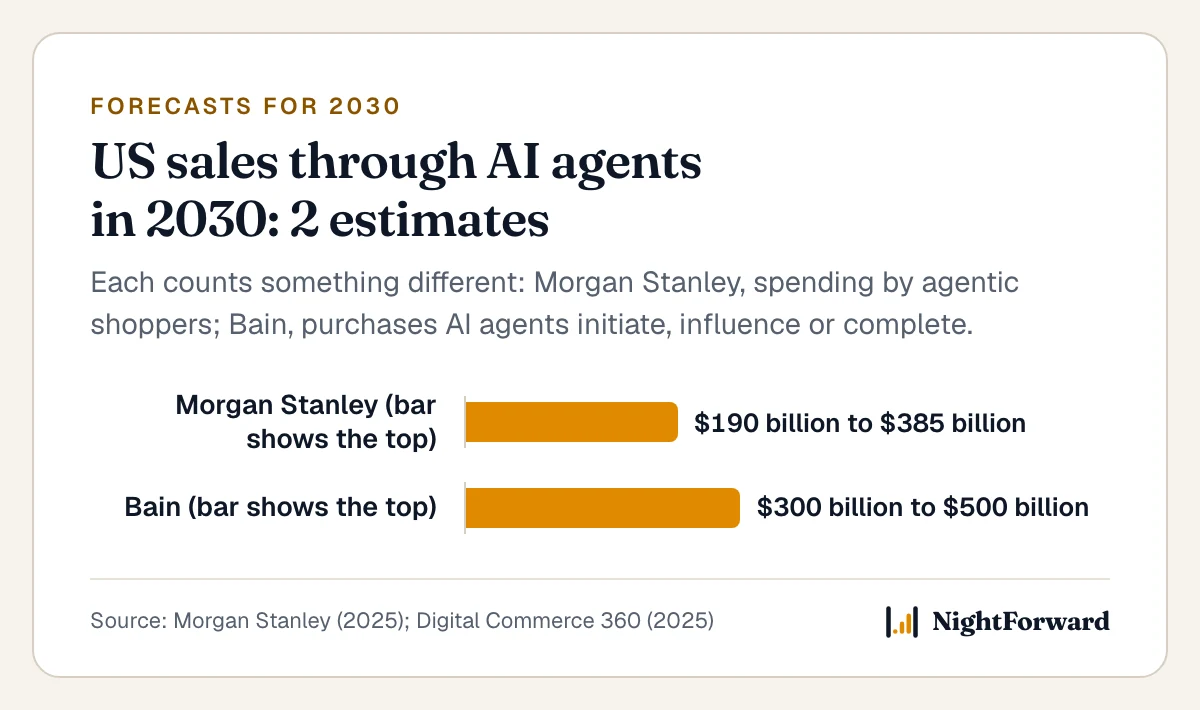
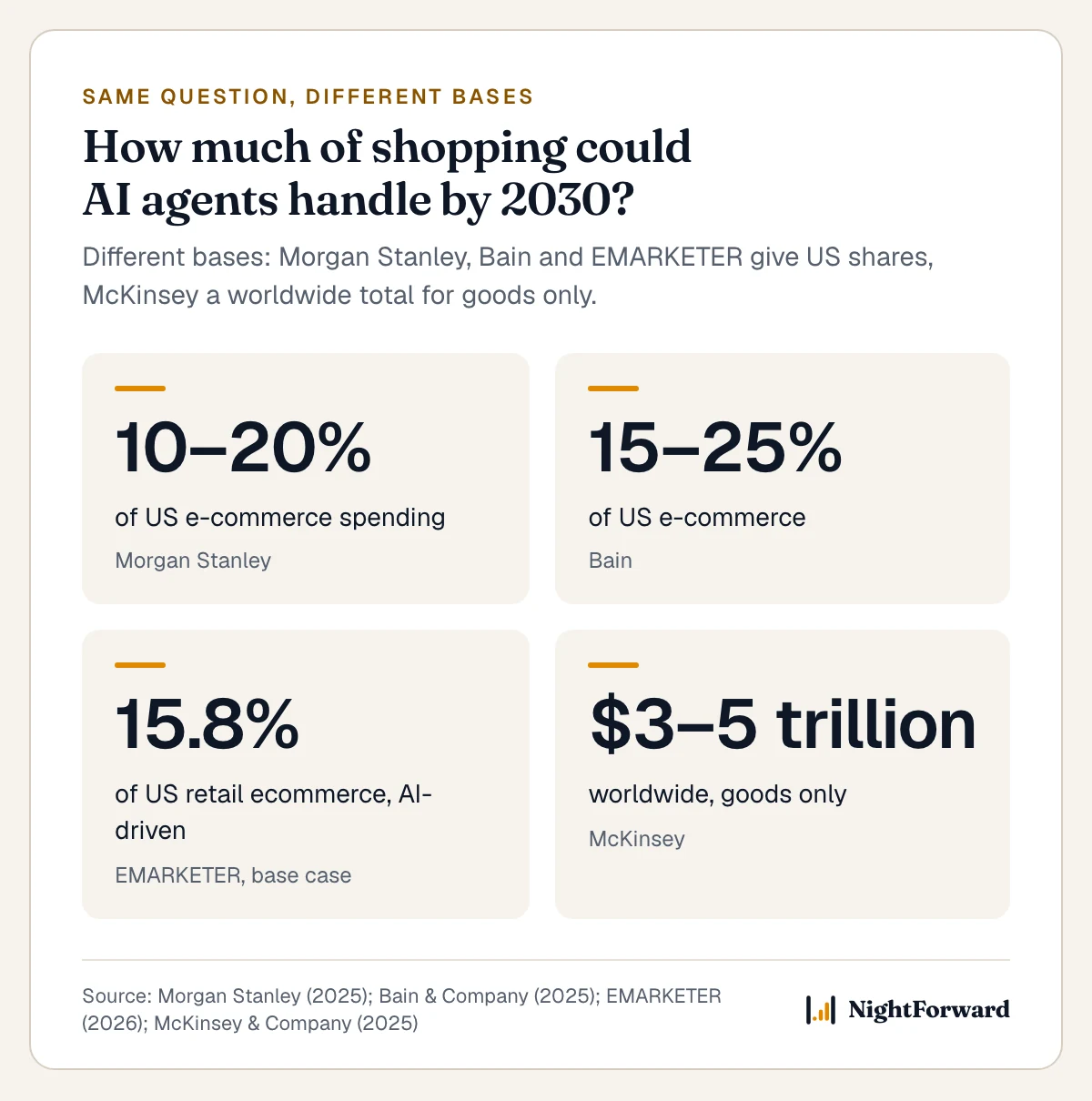
Morgan Stanley’s own report puts agentic shoppers at $190 billion to $385 billion of US e-commerce spending by 2030, capturing 10% to 20% of market share: a likely 10% share, and an optimistic outlook up to 20%15. Bain is higher: $300 billion to $500 billion, or 15% to 25% of US online retail sales13. EMARKETER’s base case is the one forecast we found that follows the same measure from today: AI-driven ecommerce sales rise from 3.2% of total US retail ecommerce in 2026 to 15.8% in 203016.
For scale, US retail e-commerce sales were $340.2 billion in the second quarter of 2026 (seasonally adjusted and preliminary), up 12.2% on a year earlier, and 17.1% of all US retail sales17. Over 2025 they came to $1,233.7 billion18. Forrester expects US e-commerce sales to reach $1.8 trillion by 2030, 29% of retail sales excluding cars and fuel19. In Great Britain, 28.8% of retail sales were made online in September 202620, an average of £2,822.5 million a week21, Mintel’s latest edition, from July 2026, expects UK online retail sales (including VAT) to hit £180 billion by 203122; its August 2025 edition had put them at £151bn by 203023. These totals are for scale only.
Globally, McKinsey projects agentic commerce could reach $3 trillion to $5 trillion by 2030, with up to $1 trillion of “orchestrated revenue” in US B2C retail alone; its figures count goods only, not services or B2B24. The Research and Markets report gives the same global range of USD 3 trillion to USD 5 trillion1.
The firms agree on direction. Morgan Stanley analyst Nathan Feather calls agentic shopping “a paradigm shift for ecommerce”14. Bain expects AI to play a role in most online shopping journeys by 2030, “even if it does not complete every transaction”13.
Why do the forecasts disagree so much?
Mostly because they count different things. A purchase AI influenced and a purchase AI completed are very different counts, and US and global figures sit on different bases.
Bain counts purchases “initiated, influenced, or completed” by third-party or retailer-hosted AI agents, leaving out journeys that only use AI-assisted search or discovery25, which is far wider than checkout alone. Salesforce figures show how much the definition matters. As cited by Bain, AI and agents influenced about $3 billion of US Black Friday sales13. As cited by Paz.ai, Salesforce reported $67 billion of global AI-influenced Cyber Week sales, with AI touching 20% of all orders3.
commercetools’ 2026 statistics roundup puts the wider effect at roughly 20% of all Cyber Week 2025 purchases worldwide, influenced by AI agents and agentic commerce26. That roundup draws on other statistics sites, so we treat it as a summary, not a primary source.
Wider still, PHD and WARC count spending an agent “facilitated”: more than $944bn of global consumer spend in 2026, 1.3% of all private consumption worldwide, tripling to $3.35 trillion in 203027. Juniper Research puts agentic commerce spend at $1.5 trillion in 203028. Salesforce says AI influenced 20% of global online sales in the 2025 holiday season, worth US$262 billion29. We found no source that measures the dollars of purchases AI agents actually completed.
Our view: read every forecast with its definition beside it, and treat the range as the message.
Are shoppers warming to letting AI buy for them?
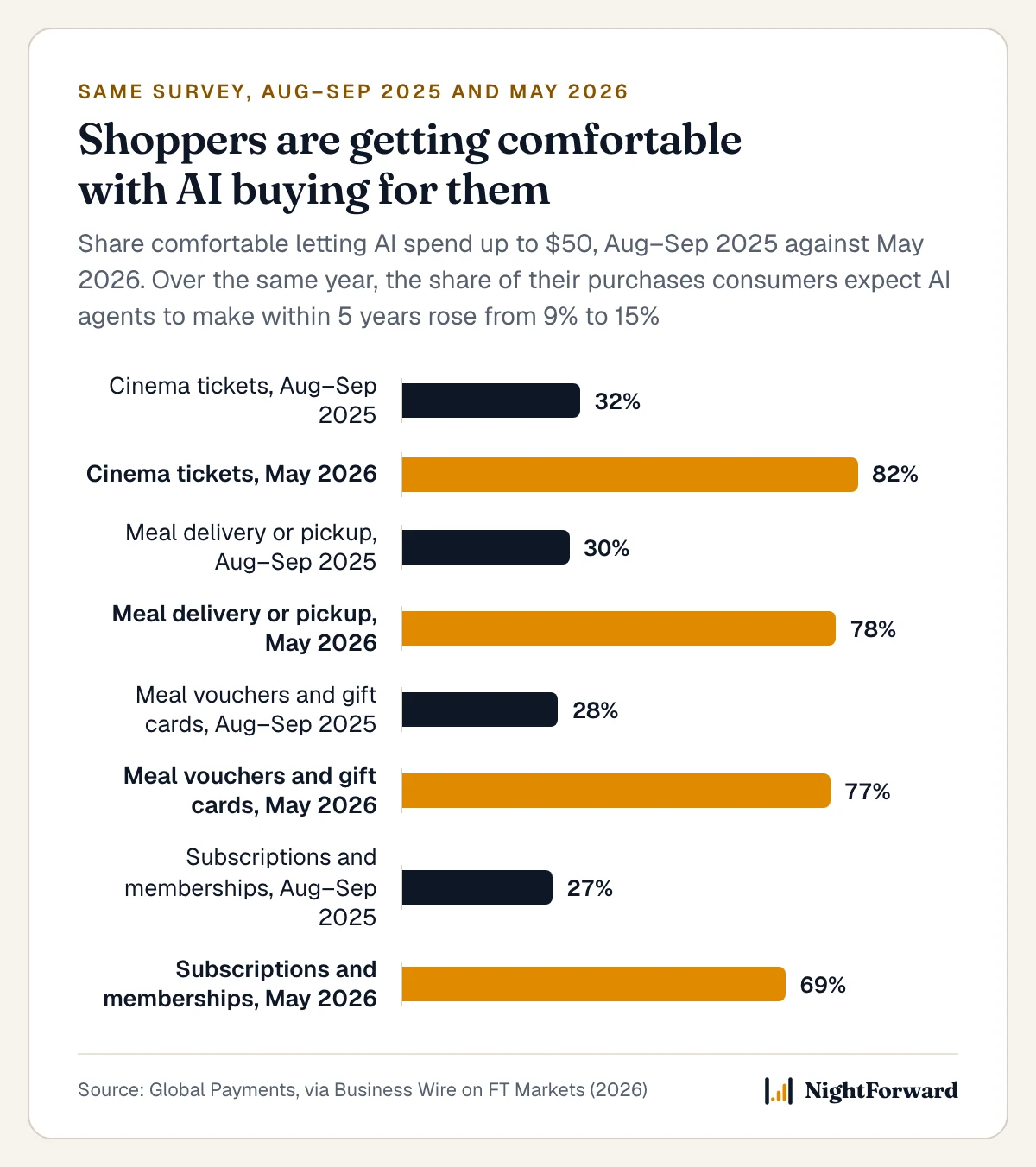
Yes, and quickly. In Global Payments’ surveys, the share of their purchases consumers expect AI agents to make within 5 years rose from 9% to 15% in a single year.
The 2 survey waves were run by The Lantern with Global Payments: 8,000 consumers in August–September 2025 and 8,027 in May 2026, in the US, UK, France, Brazil, China, Singapore and Australia30. Because the same markets were asked twice, the change is a like-for-like trend.
In several everyday categories, shoppers are more than twice as likely as a year earlier to be comfortable letting AI spend up to $50. Cinema tickets went from 32% to 82%, and subscriptions from 27% to 69%30. The release also reports that 45% of Americans have used, or would consider using, an AI shopping agent30.
One publisher has put a dollar value on such an expectation, and it did the sum itself. In 2025, Worldpay found US shoppers expected around 9% of their total online purchases to be made by AI agents by 2030; on a US e-commerce market it projects at $2.9 trillion in 2030, that is over $261 billion31. Global Payments’ 2026 release gives no dollar value for the 15%30.
Brand loyalty is in play too. In Checkout.com’s research, 57% of consumers would let an AI shopping agent switch brands if it found a better-value option8.
Which purchases will AI agents take over first?
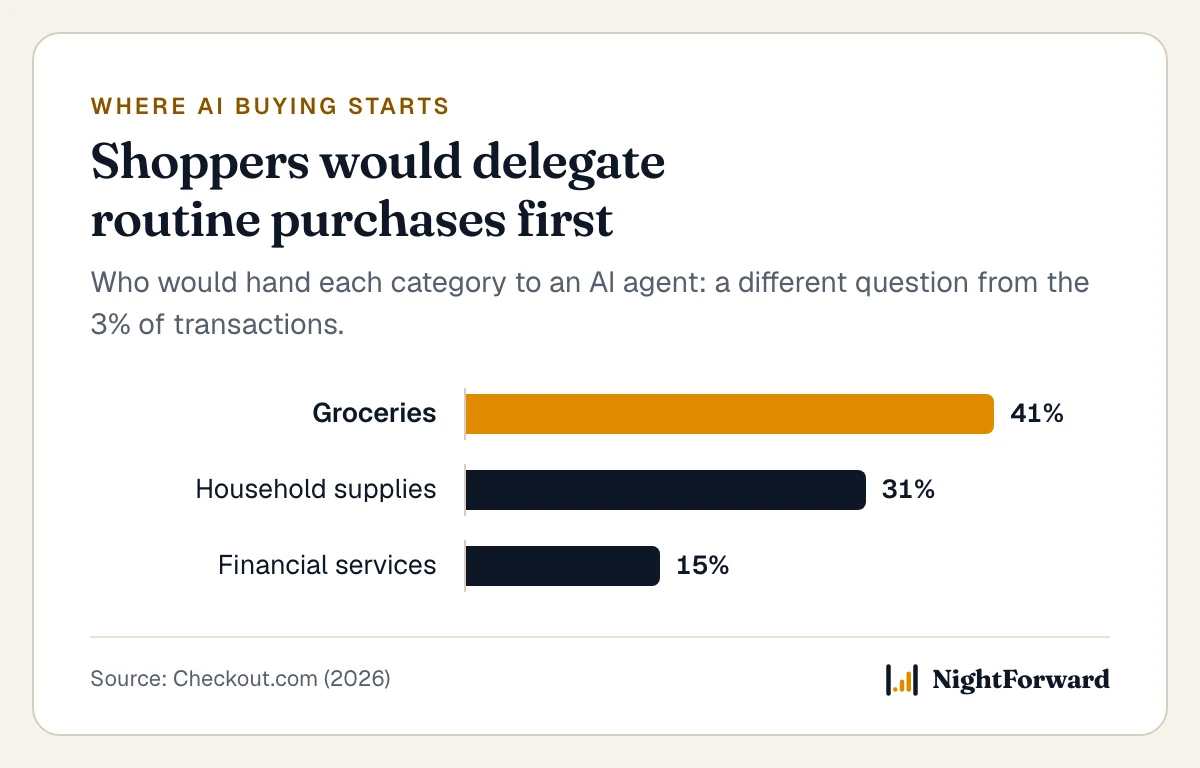
Routine, low-risk ones. Consumers are most willing to hand over groceries (41%) and household supplies (31%), and least willing for financial services (15%).
Those figures are from Checkout.com, which notes that merchants had expected complex decisions such as financial products to go first8. Shoppers see it the other way round: groceries and household supplies are “lower-risk, repeatable purchases”, and shoppers say they will only delegate spending to an AI agent if strict controls exist8.
Others point the same way. Morgan Stanley’s survey finds grocery and consumer packaged goods lead AI-driven purchases, and its analysts see them as the fastest-growing categories to 2030 because people buy them often and repeatedly14. Bain expects purchases decided on price, speed and availability, such as household essentials, to “shift first”, with apparel and travel following more gradually13.
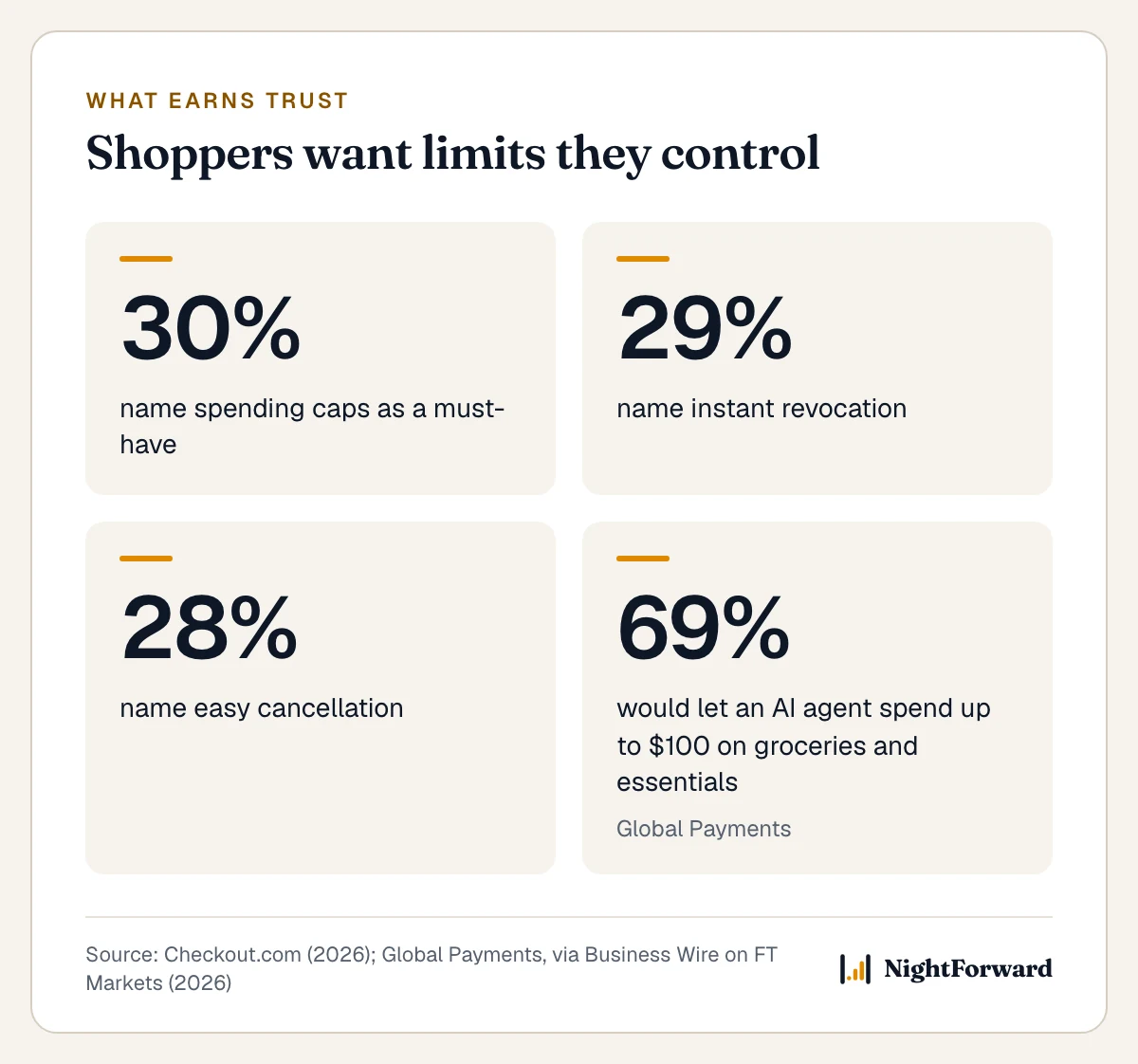
Spending limits shape it as well. In Global Payments’ survey, 69% would let an AI agent spend up to $100 on groceries and everyday essentials30. The grocery prize is large: US online grocery sales averaged about $10.72 billion a month in 2025, according to Brick Meets Click32.
What would make shoppers trust an AI agent with their money?
Control they can see and use. Shoppers put spending caps, instant revocation and easy cancellation at the top of their list, and many still want to approve each payment.
In Checkout.com’s research, the top conditions are spending caps (30%), instant revocation (29%) and easy cancellation (28%). On average, consumers across the 6 markets surveyed would let an agent spend £177 (about $237) per purchase without extra approval, below the £200 (about $268) that merchants in the UK and US assumed8. We converted at the Bank of England’s spot rate of 1.3398 US dollars to the pound on 9 June 202633. 27% of consumers trust no business or other provider to run an AI shopping agent, and 24% say they will never delegate purchases to AI8.
Global Payments finds the same caution: 50% of Americans are concerned about the security of their payment details, and 33% want to approve every transaction before a payment is made30.
For a business, this is familiar ground. An agent that spends money needs limits and an off switch, just like an agent that works inside your business.
How are other businesses preparing?
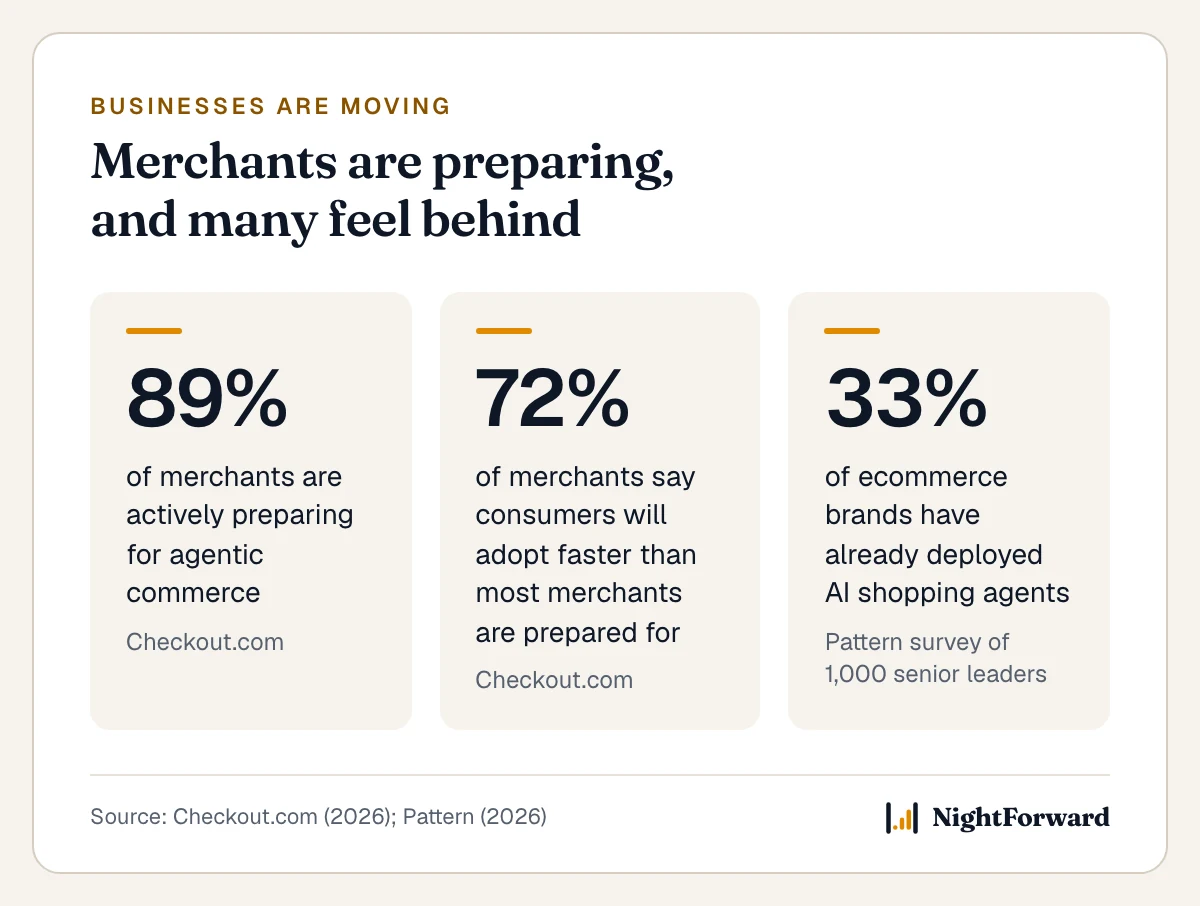
Many already are. 89% of merchants in Checkout.com’s research are actively preparing for agentic commerce, and 33% of ecommerce brands in Pattern’s survey have deployed AI shopping agents.
Pattern surveyed 1,000 senior business leaders in the US, UK, Germany and the United Arab Emirates, published in January 2026. 33% have deployed AI-powered shopping agents and 76% have reduced customer acquisition costs. In the release’s words, “Eighty-seven percent of respondents expect AI-powered search to drive direct sales growth over the next 12 months”34. Pattern sells ecommerce services, so read it as a vendor’s survey.
Checkout.com adds that 72% of merchants think consumers will adopt agent-led shopping faster than most merchants are prepared for8.
Bain’s warning is about control. Retailers without an agentic commerce strategy, it says, “risk ceding control over customer data, checkout and fulfillment to third-party AI platforms”13.
What might AI shopping look like after 2030?
Nobody knows, and the forecasts disagree even about today. Anything past 2030 below is our view, labelled as such, not a forecast.
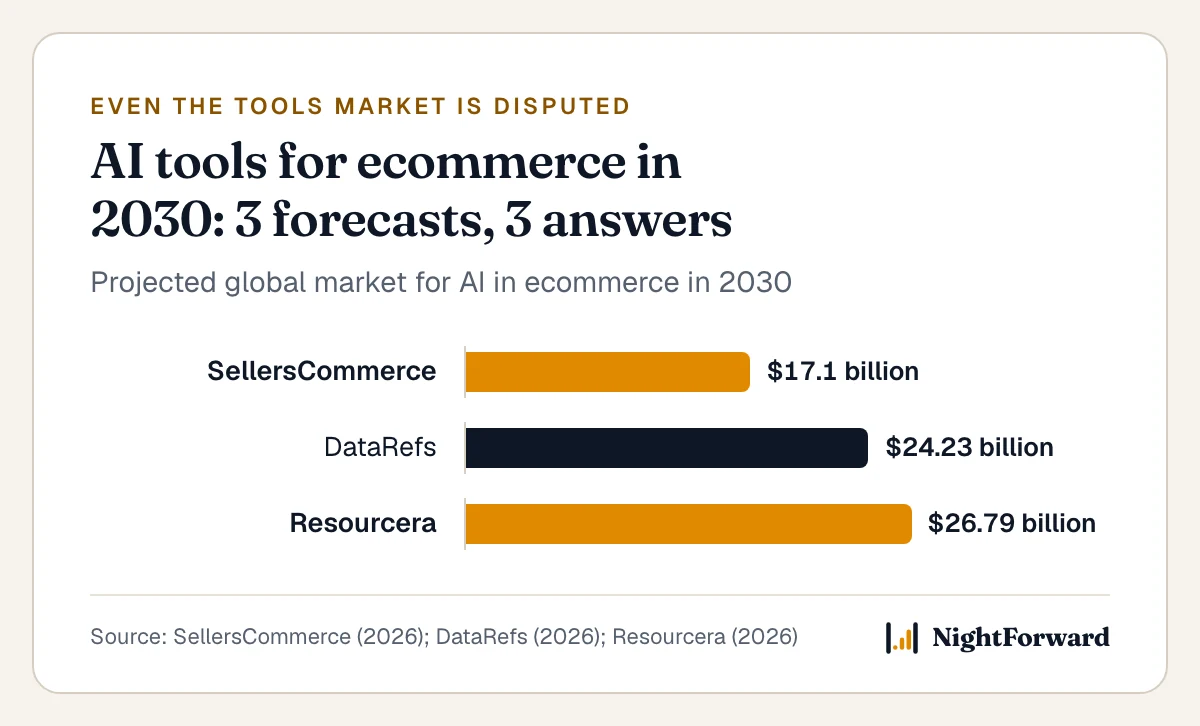
Market researchers can’t agree on the size of the market for AI tools in ecommerce, which is a narrower thing than sales made through AI. For 2026, estimates include $9.70 billion35 and $11.21 billion36. For 2030, they include $17.1 billion37, $24.23 billion35 and $26.79 billion36. One projection runs to $74.93 billion by 203536.
Our view: if the trends above hold, the 2030s look less like robots doing all the shopping and more like a split. Routine refills and essentials get bought by agents within limits shoppers set. Considered purchases still start with an AI conversation and end with a person’s click. Either way, the shops that get chosen are the ones whose products, prices and stock an assistant can read and trust.
Paz.ai, which sells AI visibility services, argues that making products discoverable by AI agents “is becoming as central as SEO was for the search engine era” (SEO being the work of getting found in search engines)3. We think that is right in direction, though the evidence so far is about traffic, not yet sales.
What should your business do now?
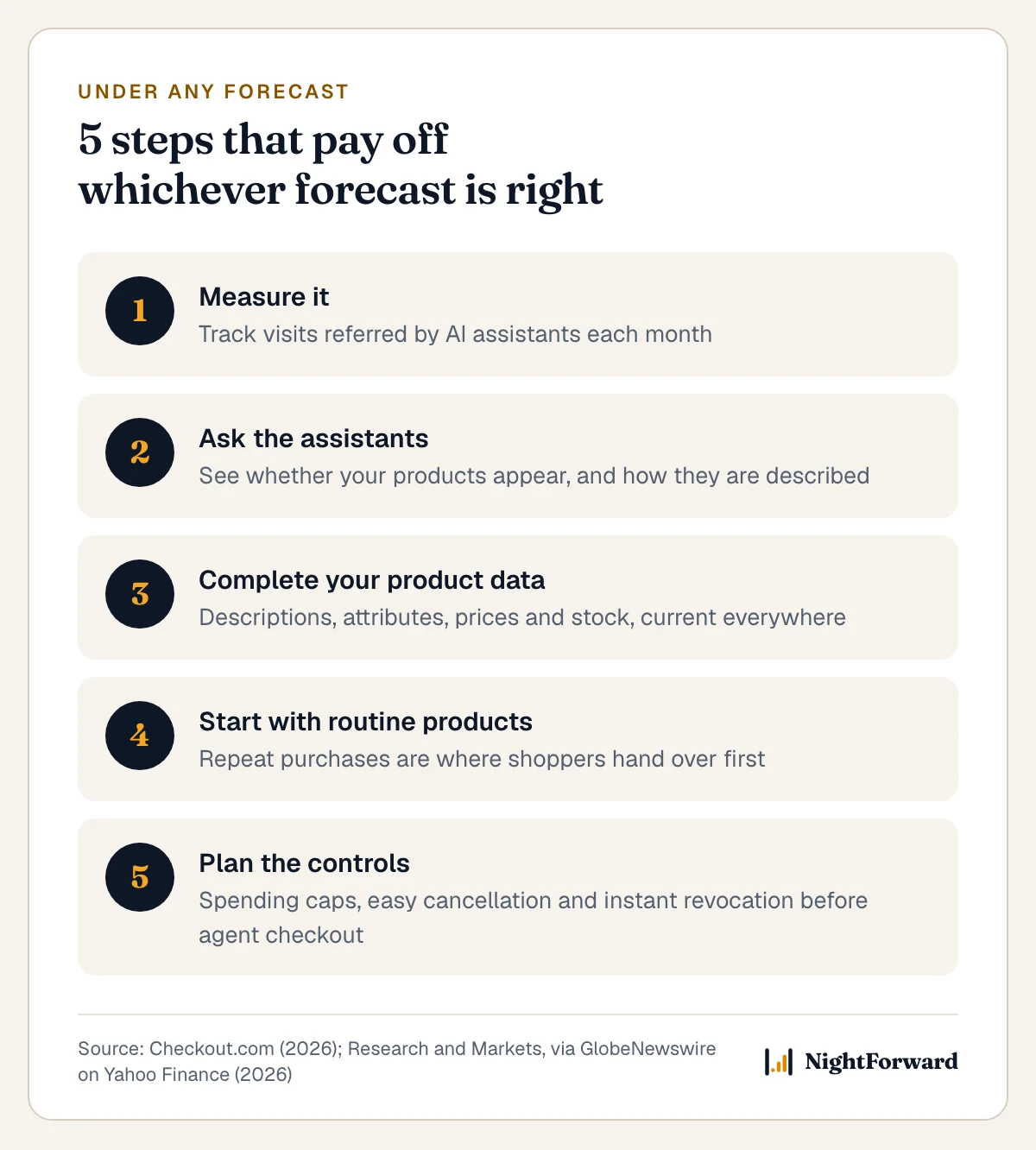
Start with what pays off under any forecast: be easy for AI assistants to find and read, measure the traffic they send, and prepare the controls shoppers say they want.
- Measure it. In your analytics, look for visits referred by AI assistants and note the number each month. Your own trend beats any industry average.
- Ask the assistants. Ask 2 or 3 AI assistants for the kind of product you sell. See whether you appear, and what they say about you.
- Make your product data complete. Full descriptions and attributes, current prices and stock, on your site and in your feeds. As the Research and Markets report puts it, brands must consider how “product data, availability, pricing and merchant information are interpreted and presented by AI platforms”1. Workflow tools can keep feeds in step with your stock system, and they are deterministic: the same input gives the same result every time.
- Start with routine products. Repeat purchases are where shoppers say they would hand over first.
- Plan the controls before agent checkout. Spending caps, easy cancellation and a way to revoke access at once.
None of this needs a bet on a single forecast. In our view the window to be early is open now, and it won’t stay open long: merchants are already preparing8.
Want the whole story on 1 page?
The poster below puts every number from this piece together, from the first AI visit to after the sale. The sections above explain each part.
Get new updates
Articles, news and offers from NightForward.
Researched and drafted with AI tools, fact-checked against the sources below, and edited by Kringle Lam.
Sources
- Research and Markets, via GlobeNewswire on Yahoo Finance, AI Shopping Agents and Agentic Commerce 2026: Adoption Trends and Execution Limits (opens in a new tab) (17 August 2026)
- Adobe, Adobe: Cyber Monday 2024 recap (opens in a new tab) (3 December 2024)
- Paz.ai, Agentic Commerce in 2026: How AI Agents Buy Products (opens in a new tab) (17 October 2026)
- Adobe, Adobe: Cyber Monday hits record (opens in a new tab) (2 December 2025)
- Marketing Dive, reporting Adobe's Quarterly AI Traffic Report, AI has changed holiday shopping. Here's what the numbers say (opens in a new tab) (23 January 2026)
- Adobe, Adobe: US holiday shopping season to hit record (opens in a new tab) (28 September 2026)
- techcrunch.com, AI traffic to US retailers rose 393% in Q1, and it's boosting their revenue too | TechCrunch (opens in a new tab) (16 April 2026)
- Checkout.com, Consumer demand for AI shopping is forming fast but trust for agentic commerce is still catching up (opens in a new tab) (9 June 2026)
- Capital One Shopping, AI Shopping Statistics (opens in a new tab) (21 October 2026)
- TechCrunch, with Adobe data, Prime Day event drove over $24B in US e-commerce sales, GenAI traffic was up 3,300% (opens in a new tab) (14 July 2025)
- Digital Commerce 360, with Adobe data, Amazon Prime Day sales (opens in a new tab) (29 June 2026)
- FedEx, No-box, no-label returns and AI adoption on the rise as consumers seek convenience for returns (opens in a new tab) (9 January 2026)
- Digital Commerce 360, Bain: Agentic AI could account for 25% of U.S. ecommerce by 2030 (opens in a new tab) (22 December 2025)
- Digital Commerce 360, Morgan Stanley: AI ‘agentic shoppers’ could drive $385 billion in online sales (opens in a new tab) (9 December 2025)
- Morgan Stanley, Here Come the Shopping Bots (opens in a new tab) (8 December 2025)
- EMARKETER, US Ecommerce 2026 (opens in a new tab) (27 August 2026)
- US Census Bureau, Quarterly Retail E-Commerce Sales, 2nd Quarter 2026 (opens in a new tab) (18 August 2026)
- US Census Bureau, Quarterly Retail E-Commerce Sales, 4th Quarter 2025 (opens in a new tab) (10 March 2026)
- Forrester, US Retail In 2030: E-Commerce Expands, Stores Still Matter (opens in a new tab) (28 January 2026)
- Office for National Statistics, Retail sales, Great Britain: September 2026 (opens in a new tab) (23 October 2026)
- Office for National Statistics, Internet sales, average weekly value, all retailing excluding fuel (series MZX6) (opens in a new tab) (23 October 2026)
- Mintel, UK Online Retailing: The Purchase Journey 2026 (opens in a new tab) (29 July 2026)
- Mintel, UK Online Retailing Market Report 2025 (opens in a new tab) (August 2025)
- McKinsey & Company, The agentic commerce opportunity: How AI agents are ushering in a new era for consumers and merchants (opens in a new tab) (17 October 2025)
- Bain & Company, 2030 Forecast: How Agentic AI Will Reshape US Retail (opens in a new tab) (17 December 2025)
- commercetools, AI and agentic commerce statistics 2026: Market size, adoption and trends for enterprise leaders (opens in a new tab) (8 October 2026)
- PHD and WARC, The $3 trillion global agentic transaction economy (opens in a new tab) (July 2026)
- Juniper Research, Agentic Commerce Set to Generate $1.5 Trillion Globally by 2030 (opens in a new tab) (7 April 2026)
- Salesforce, As AI Agents Transform Commerce, Salesforce Unleashes Its Biggest Agentforce Commerce Release Yet (opens in a new tab) (6 July 2026)
- Global Payments, via Business Wire on FT Markets, Consumers Expect AI to Make 15% of Their Purchases Within Five Years, Global Payments Research Finds (opens in a new tab) (23 September 2026)