AI & Automation · 13 October 2026 · 7 min read
Is AI taking jobs? What the numbers say, and where to watch
In October 2026, an AI model wrote 719 mathematics papers and many mathematicians feared for their students. The job figures tell a calmer story, with 1 place to watch: the entry door for young people.

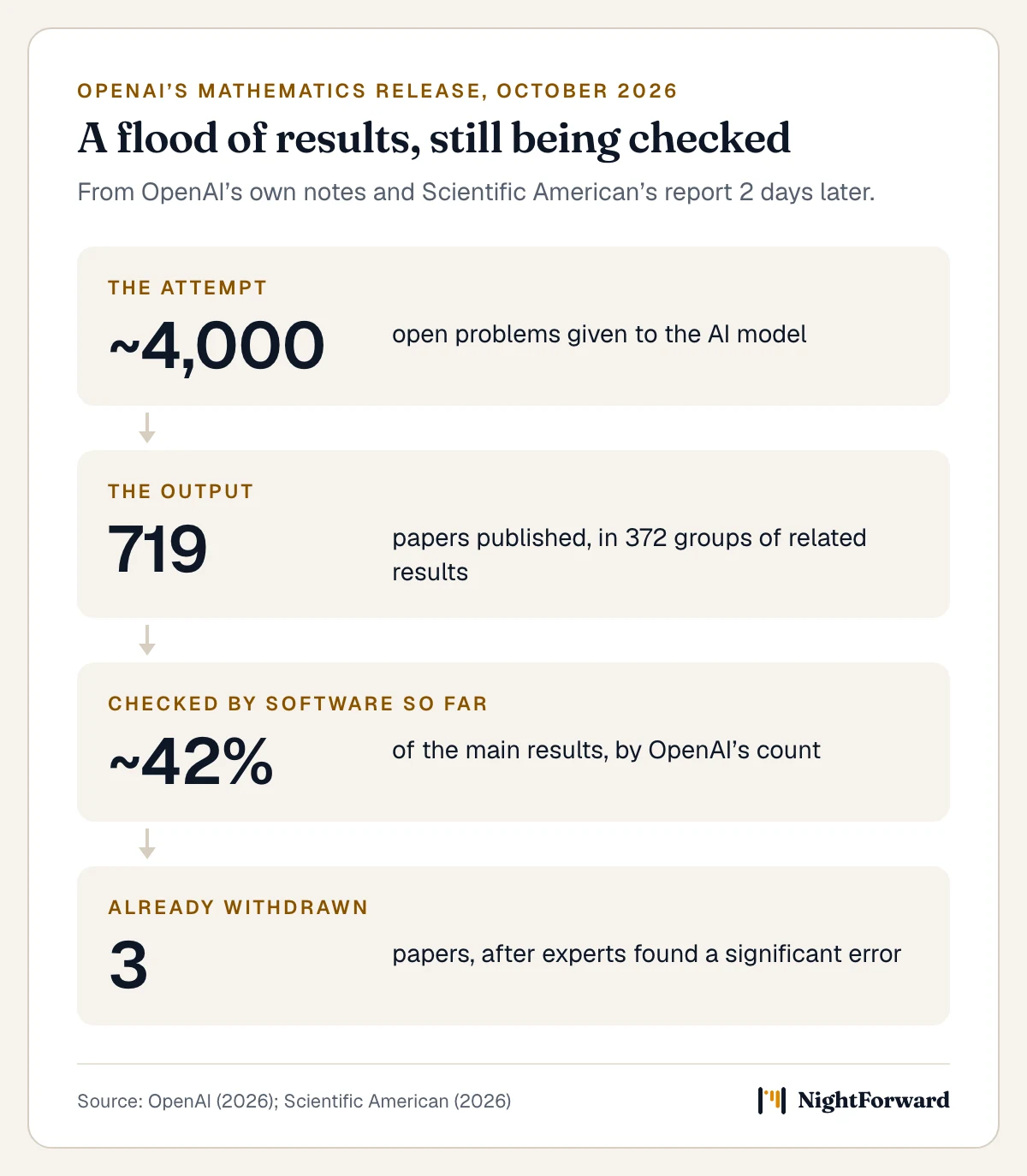
Is AI taking jobs? Not at scale, on the figures so far. On 6 October 2026, OpenAI published 719 mathematics papers written by an AI model12, and many mathematicians have spent the days since worrying about their students. We think it is a real milestone for what AI can do. The job figures tell a calmer story, with 1 place that deserves your attention: the entry door for young people.
What young people can do about it has its own article: Is a degree still worth it with AI?
What did OpenAI release, and why are mathematicians upset?
719 papers in 372 groups of related results, all written by an unreleased AI model. The quality is uneven, and the checking has only begun.
OpenAI says the model was given approximately 4,000 open problems, and that about 42% of the main results have so far been checked step by step by software (also known as formal verification)1. Just 2 days after the release, Scientific American reported that 3 of the papers had already been withdrawn after experts found a significant error. Mathematicians, it wrote, “are finding some papers readable and others utterly nonsensical”3.
The reactions run from awe to grief. A mathematics blog collected over 100 of them, and concern for younger researchers “runs through nearly all the responses”2. A PhD student learned that morning that OpenAI claimed to have proved the problem at the heart of his dissertation, and described panic over his applications for his next post2. Terence Tao, a winner of the Fields Medal, wrote that the proofs appear to “introduce clever new ideas that will be fruitful once digested”2.
The worry is real. Is it showing up in the job figures?
Is AI causing unemployment?
Not that the totals show. Unemployment in the US, the UK, the euro area and Canada has stayed close to where it stood earlier this year or a year ago.
- US: 4.2% in September 2026, in a range of 4.1% to 4.3% since March4.
- UK: 4.9% in May to July 2026, up 0.2 percentage points on the year and largely unchanged on the quarter5.
- Euro area: 6.4% in August 2026, against 6.3% a year earlier6.
- Canada: 6.5% in September 2026, the same as in January7.
Each figure comes from its own survey and period, so read each against its own past, not against the others.
The Budget Lab at Yale follows this question with US data to August 2026. Its finding: “Measures of AI usage show no connection to changes in employment or unemployment”8. For the euro area, Philip Lane of the European Central Bank’s Executive Board said in March 2026 that “there is currently little evidence of a substantial effect of AI on employment”9.
We think 1 reason is simple: most businesses have not adopted AI yet. In Canada, 19.2% of businesses had used AI in the 12 months before the survey in the second quarter of 202610. The official figures for the US and the EU are in Is everyone using AI except you?
What about layoffs blamed on AI? US employers cited AI for about 21% of the job cuts they announced through September, more than any other stated reason11. 2 things sit beside that. Total announced cuts are down 39% on the same months of 2025, and in September itself AI was cited for about 9%11. A reason given in an announcement is also not a measured cause.
Are companies using AI to replace workers?
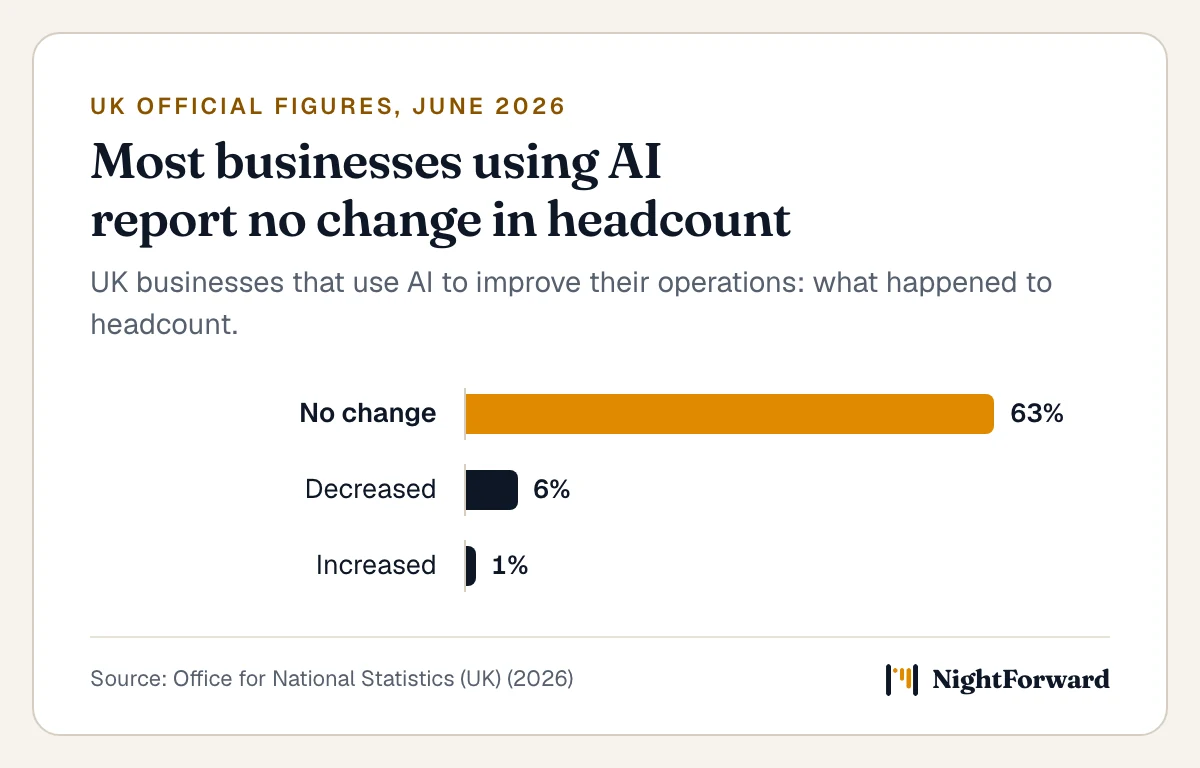
Mostly not, so far. In UK surveys, most businesses using AI report no change in headcount, and in PwC’s figures the companies most exposed to AI grew their teams faster than the rest.
- UK, official figures for June 2026: of businesses using AI to improve their operations, 63% reported no change in headcount, 6% a decrease and 1% an increase12.
- UK, British Chambers of Commerce, published March 2026: 95% of small and medium businesses using AI said it had made no difference to the size of their workforce over the past year13.
- Euro area: AI “is primarily used to improve core and non-core processes, and less for reducing personnel costs”, and the central bank’s analysis finds AI use “has been neutral for employment so far”9.
- Canada, second quarter of 2026: 32.0% of businesses using AI had trained their existing employees for it10.
Then there is growth. PwC studied more than 1 billion job ads and company figures. From 2018 to 2025, headcount at the companies most exposed to AI grew 52%, against 36% at the least exposed. Productivity grew 34%, against 24%14. Ramp, working from company spending records, studied more than 21,000 US firms and found that those adopting AI grew headcount 10.2% over the following 2 years, a gain that came entirely from the heaviest users15.
A caution belongs here. Ramp notes those firms were “already larger” and “faster-growing” before they adopted AI15. The evidence shows AI and growth arriving together. It does not show that AI caused the growth. We also looked for solid evidence that AI is already lifting revenue or earnings across companies, and found none we could verify.
Will AI replace entry-level jobs?
This is the place to watch. The strongest warning comes from US payroll records, and other studies disagree.
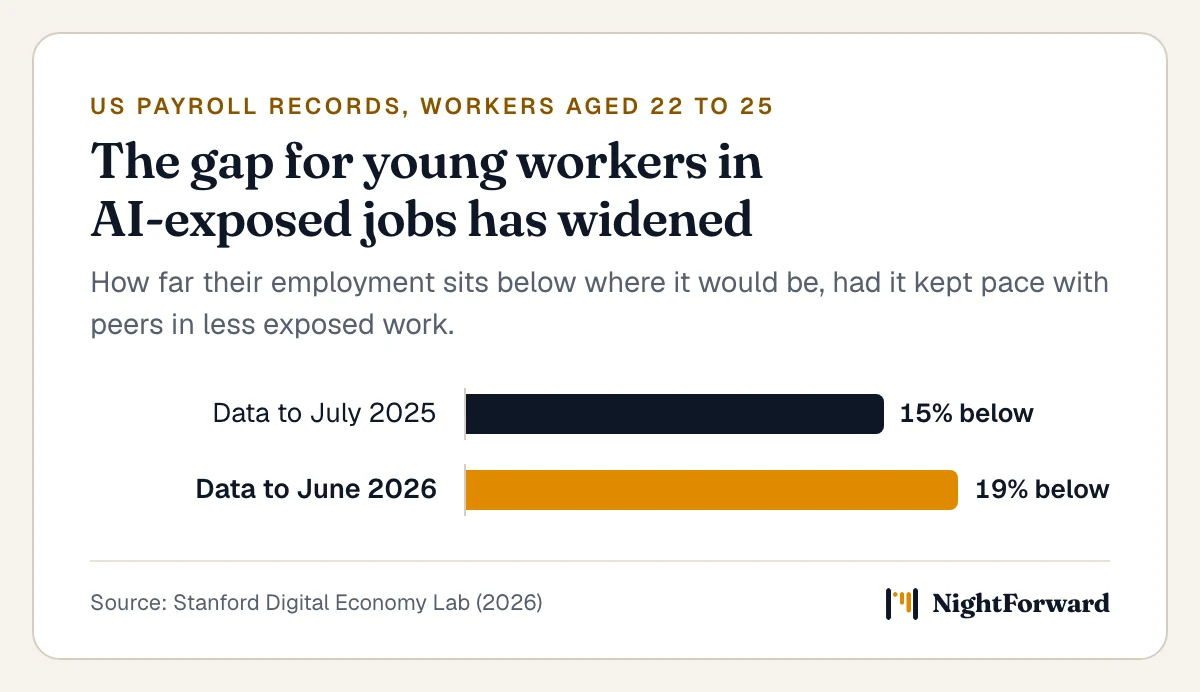
Stanford researchers follow US payroll records from ADP. Their August 2026 update finds employment among workers aged 22 to 25 in the occupations most exposed to AI is about 19% below where it would be had it kept pace with their peers in less exposed work. A year earlier the gap was 15%. Experienced workers show “no comparable gap”16. It works “primarily through reduced hiring of young workers rather than increased separations”: fewer are let in, not more let go16. The authors are careful: “These are descriptive patterns, not causal estimates of the effect of AI”16.
Others see it differently. The New York Fed studied US job ads and concluded that AI “is not the main driver of the slowdown in hiring”, with no split between junior and senior roles in the most exposed occupations17. And at the companies investing most in AI, Ramp found entry-level headcount grew 12%15.
What has clearly changed is what a first job asks for. In US job ads, PwC found entry-level roles most exposed to AI are 7 times more likely to require skills once expected of senior people. Openings for those roles have grown 35% since 2019, while other entry-level roles shrank 10%14.
One Stanford detail shows where the pressure falls. The decline for young workers is in occupations that lean on “codified knowledge”, the kind found in textbooks and written procedures. Employment rose for experienced workers in jobs that lean on “tacit knowledge acquired through practice, mentorship, and repeated exposure to real situations”16.
What does this mean for your team?
Expect AI to change tasks before it changes headcount, and protect the route by which juniors become experienced people. That is our reading of the evidence so far, not a forecast.
- Train the people you have. The New York Fed’s business surveys indicate that firms “intend to incorporate AI mainly via retraining, with limited effects on hiring”17.
- Keep the entry door open. PwC puts the risk well: AI is “removing some of the routine work that once acted as an apprenticeship”14. If nobody trains juniors today, there will be fewer experienced people in a few years to check what the machines produce.
- Watch the figures, not the headlines. The Stanford authors say they do not know whether the pattern they found will speed up, level off or reverse16. The figures above are updated every month or quarter, so the answer can change.
For the young people in your life, the question is what to study and how. We cover it in Is a degree still worth it with AI?
Get new updates
Articles, news and offers from NightForward.
Researched and drafted with AI tools, fact-checked against the sources below, and edited by Kringle Lam.
Sources
- OpenAI, openai/math: mathematical manuscripts and supporting proof artifacts produced by an internal OpenAI model (opens in a new tab) (6 October 2026)
- The Decoder, “How much beauty have we lost?” Mathematicians react with shock and disgust as OpenAI bulldozes their field (opens in a new tab) (10 October 2026)
- Scientific American, Mathematicians marvel, and grumble, at OpenAI’s trove of new results (opens in a new tab) (8 October 2026)
- US Bureau of Labor Statistics, Unemployment rate little changed at 4.2 percent in September 2026 (opens in a new tab) (9 October 2026)
- Office for National Statistics (UK), Employment in the UK: September 2026 (opens in a new tab) (15 September 2026)
- Eurostat, Unemployment statistics (data up to August 2026) (opens in a new tab) (1 October 2026)
- Statistics Canada, Labour Force Survey, September 2026 (opens in a new tab) (9 October 2026)
- The Budget Lab at Yale, Tracking the Impact of AI on the Labor Market (updated with data to August 2026) (opens in a new tab) (15 September 2026)
- European Central Bank, AI and the euro area economy (speech by Philip R. Lane, Member of the Executive Board) (opens in a new tab) (23 March 2026)
- Statistics Canada, Analysis on artificial intelligence use by businesses in Canada, second quarter of 2026 (opens in a new tab) (11 June 2026)
- Challenger, Gray & Christmas, Job Cuts Fall in September; Hiring Plans Up 3% Over 2025 On Weak Early Seasonal Hiring (opens in a new tab) (1 October 2026)
- Office for National Statistics (UK), Artificial intelligence in UK businesses: 2023 to 2026 (opens in a new tab) (20 July 2026)
- British Chambers of Commerce, Half of SMEs Using AI - With Limited Headcount Impact So Far (opens in a new tab) (18 March 2026)
- PwC, AI reshapes global labour market into two distinct paths, rewarding human skills: PwC 2026 Global AI Jobs Barometer (opens in a new tab) (15 June 2026)
- Ramp, Companies hire more after AI adoption (opens in a new tab) (30 June 2026)
- Stanford Digital Economy Lab, No Widespread Displacement, but the AI Employment Gap for Young Workers Has Widened to 19% (opens in a new tab) (12 August 2026)
- Federal Reserve Bank of New York, Liberty Street Economics, Do Job Postings Show Early Labor-Market Effects of AI? (opens in a new tab) (14 May 2026)