AI & Automation · 13 October 2026 · 6 min read
Is a degree still worth it with AI? Why study matters more, not less
AI can now write mathematics papers, and students and parents are asking whether study is still worth the effort. We think a solid foundation matters more than before: it is what lets a person check, judge and steer what AI produces. Here is the evidence, and what to do at each age.
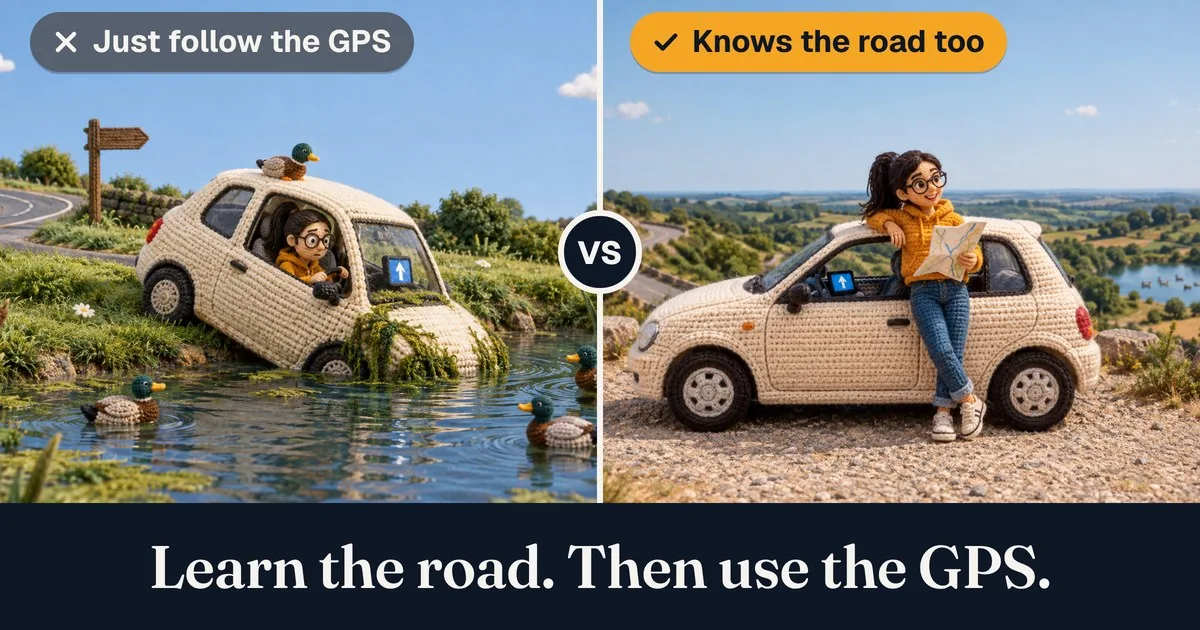
Is a degree still worth it with AI? In the latest figures, yes: graduates are still more likely to be in work. The harder question sits underneath. If AI can answer almost anything, is the studying itself still worth the effort? We think it matters more than before, and the research so far points the same way.
Why are students and parents worried about AI?
Because AI now produces work that used to mark a person as an expert, and the first step on the career ladder looks narrower.
On 6 October 2026, OpenAI published 719 mathematics papers written by an AI model12. A PhD student learned that morning that OpenAI claimed to have proved the problem at the heart of his dissertation. Among the mathematicians who responded in public, concern for younger researchers “runs through nearly all the responses”2.
The job figures give the worry some ground. US payroll records studied at Stanford show employment among workers aged 22 to 25 in the occupations most exposed to AI is about 19% below where it would be had it kept pace with their peers in less exposed work3. The authors call these “descriptive patterns, not causal estimates of the effect of AI”3, and other studies disagree. We set out both sides in Is AI taking jobs?
A first job also asks for more. In US job ads, PwC found entry-level roles most exposed to AI are 7 times more likely to require skills once expected of senior people4.
One detail in the Stanford work matters for everything below. The decline for young workers is in occupations that lean on “codified knowledge”, the kind found in textbooks and written procedures. Employment rose for experienced workers in jobs that lean on “tacit knowledge acquired through practice, mentorship, and repeated exposure to real situations”3. Knowing the textbook is no longer enough by itself. As the next sections show, it is still where everything starts.
Is a degree still worth it with AI?
Graduates are still more likely to be in work. But unemployment recently rose for young graduates while falling for their peers without a degree, the first such split since 2000.
Across the OECD’s member countries (2025 data, published 2026), 87% of adults with a university-level education (also known as tertiary education) were in work, against 78% of those whose highest level was upper secondary school or a non-university course after it5.
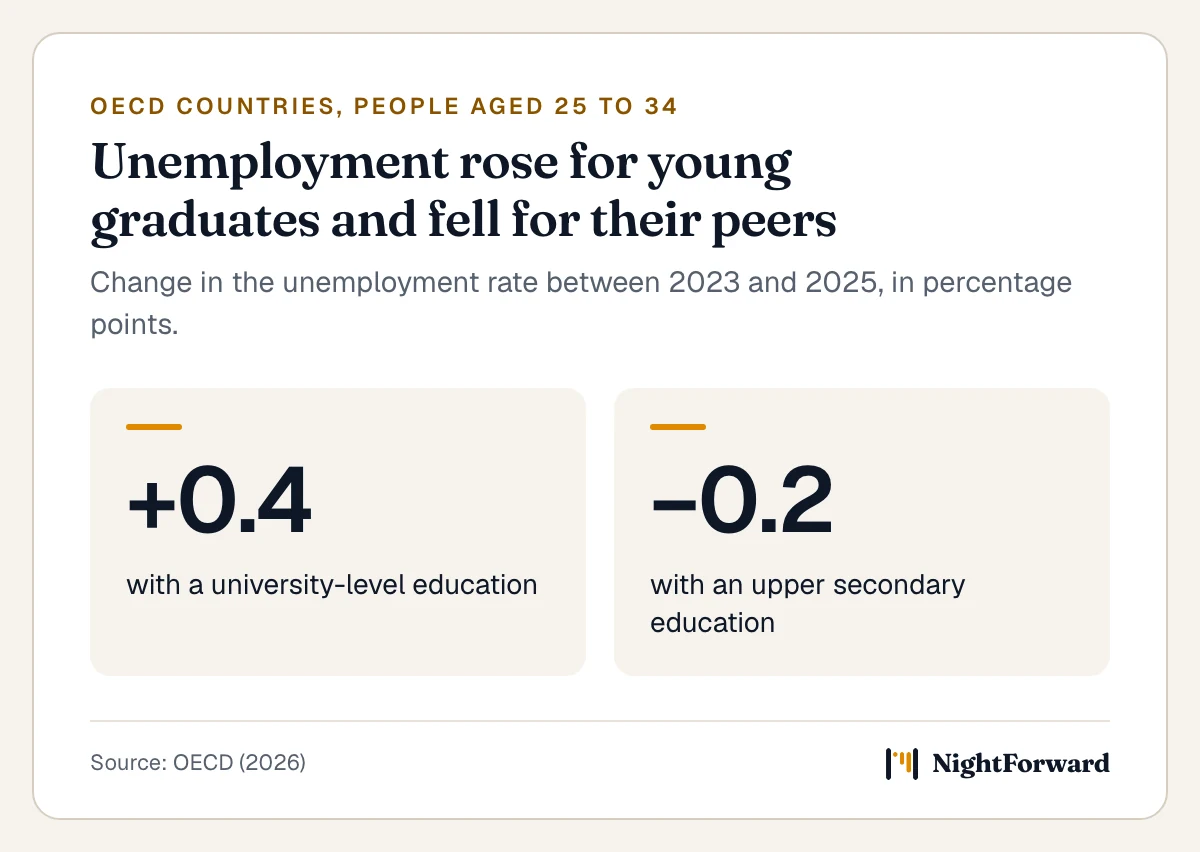
The warning sign is among the young. Between 2023 and 2025, unemployment among 25 to 34 year olds with a university-level education rose by 0.4 percentage points, while it fell by 0.2 percentage points for those with an upper secondary education. The OECD calls it “the first such divergence since the data series began in 2000”, and says it is “too early to tell” whether it is temporary6. In the US, the unemployment rate for recent graduates was about 5.6% in the second quarter of 2026. Their underemployment rate, the share working in jobs that typically do not require a degree, was 42%7.
Those who went still back the choice. In a poll of 5,934 US degree holders run in November and December 2025, 71% said their education was worth what they paid, and 93% said they would do it again8.
Our view: a degree is becoming less of a ticket by itself. What a student actually learned while earning it is what counts.
Is studying still valuable when AI can answer anything?
Yes, and we think it matters more than before. AI gives fluent answers. It takes a solid foundation of knowledge to check them, judge them and steer the work.
That is our view, so here it is plainly. The young people starting out now will work alongside AI and direct it. Without a solid foundation, they cannot check its facts, cannot tell whether an answer is right or merely sounds right, cannot tell good work from average work, and cannot steer it toward something better. The foundation is what lets a person hold the steering wheel.
Recent research points the same way.
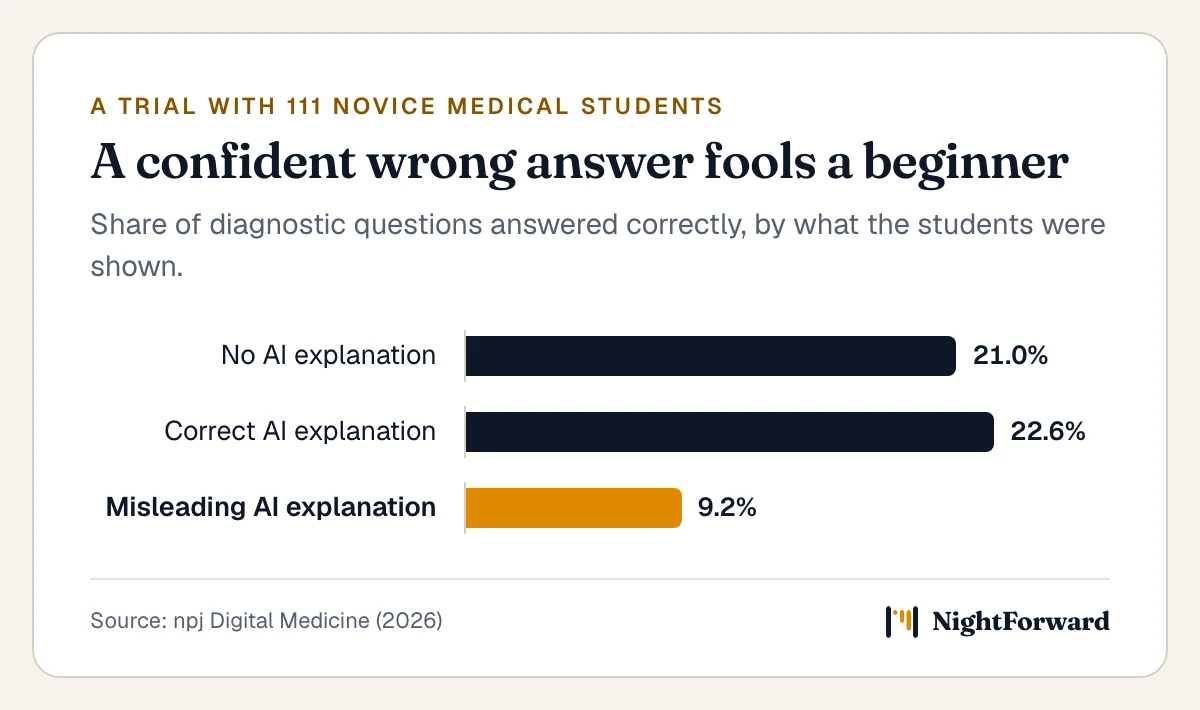
- A beginner cannot spot a confident wrong answer. In a trial with 111 novice medical students answering diagnostic questions, those working without AI got 21.0% right. Those shown plausible but misleading AI explanations got 9.2% right. Correct AI explanations (22.6%) brought no significant gain, and misled students’ confidence “remained high regardless of whether the answer was correct”9.
- AI lifts the score, and training supplies the thinking. In a trial with 1,053 first-year students at Bocconi University, those given ChatGPT wrote recommendations that judges “rated higher”. But only students trained in reasoning from first principles said when their advice would fail, explained why it should work, and “produced ideas that differed from those of their classmates”10.
Do students learn better with AI?
They can, when it is their tutor. When AI writes the work for them, the gain fades.
In a supervised experiment, university students studied an unfamiliar topic and wrote an essay with or without AI, then sat tests without help. Having AI raised their scores. But the gains “remain for students who use AI as a tutor” and “fade for students who have AI write for them”11.
Meanwhile, the practice hours are slipping. On a mathematics learning platform, time spent on the kind of problems AI can solve fell 26.9% among university students and 31.3% among high-school students after ChatGPT arrived12. Both of these are working papers that have not yet been through peer review.
The OECD names what is at risk: “the productive struggle essential for learning”. When AI removes it, students may finish faster and get better results at once, “but their understanding may be less deeply consolidated”13.
What should kids, teenagers and young adults do now?
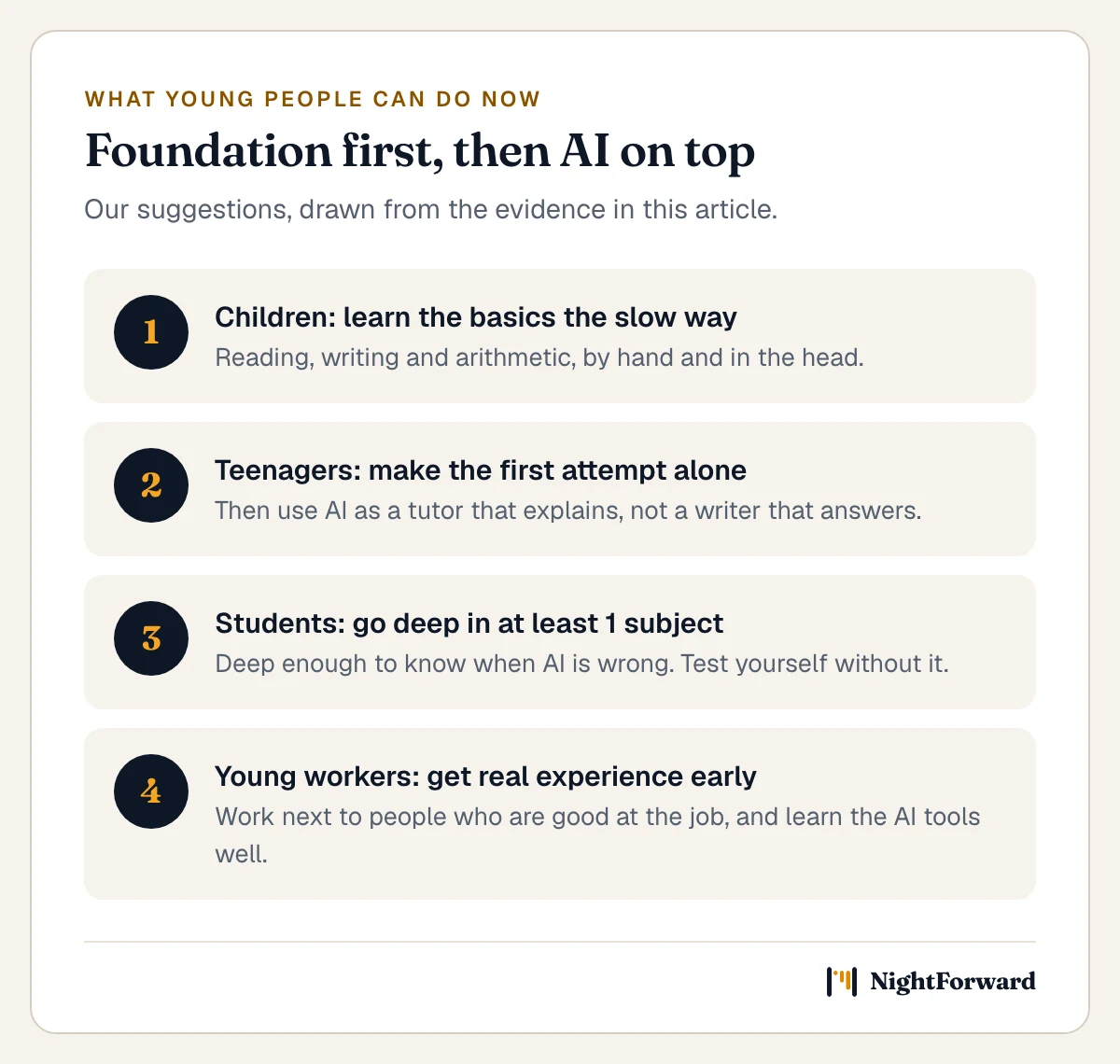
Build the foundation first, then put AI to work on top of it. These are our suggestions, drawn from the evidence above.
- Children: learn the basics the slow way. Reading, writing and arithmetic, by hand and in the head. The effort is the learning.
- Teenagers: make the first attempt alone. Then use AI as a tutor that asks questions and explains, not as a writer that hands over the answer.
- Students: go deep in at least 1 subject, deep enough to know when AI is wrong about it. Test yourself without AI, and treat checking AI’s work as a skill of its own.
- Young workers: get real experience early, next to people who are good at the job. That is where tacit knowledge comes from. Learn the AI tools well too: PwC puts the average wage premium for AI skills at 62%4.
And for anyone who hires: keep the entry door open. PwC puts the risk well: AI is “removing some of the routine work that once acted as an apprenticeship”4. If nobody trains juniors today, there are no experienced people in a few years to check what the machines produce.
Get new updates
Articles, news and offers from NightForward.
Researched and drafted with AI tools, fact-checked against the sources below, and edited by Kringle Lam.
Sources
- OpenAI, openai/math: mathematical manuscripts and supporting proof artifacts produced by an internal OpenAI model (opens in a new tab) (6 October 2026)
- The Decoder, “How much beauty have we lost?” Mathematicians react with shock and disgust as OpenAI bulldozes their field (opens in a new tab) (10 October 2026)
- Stanford Digital Economy Lab, No Widespread Displacement, but the AI Employment Gap for Young Workers Has Widened to 19% (opens in a new tab) (12 August 2026)
- PwC, AI reshapes global labour market into two distinct paths, rewarding human skills: PwC 2026 Global AI Jobs Barometer (opens in a new tab) (15 June 2026)
- OECD, Education at a Glance 2026: How does educational attainment affect participation in the labour market? (2025 data) (opens in a new tab) (29 September 2026)
- OECD, Education at a Glance 2026 (2025 data) (opens in a new tab) (29 September 2026)
- Federal Reserve Bank of New York, The Labor Market for Recent College Graduates (data to the second quarter of 2026) (opens in a new tab) (2026)
- Inside Higher Ed, As AI Use Spreads, Graduates Say Their Degree Was Worth It (Lumina Foundation and Gallup poll run in November and December 2025) (opens in a new tab) (12 May 2026)
- npj Digital Medicine, Impact of AI misinformation on diagnostic accuracy and confidence calibration in novice medical students (opens in a new tab) (17 March 2026)
- VoxEU (CEPR), Training novices to think in the age of large language models (opens in a new tab) (1 October 2026)
- arXiv (working paper by Zara Contractor and Germán Reyes), Experimental Evidence on the Learning Impact of Generative AI (opens in a new tab) (9 July 2026)
- arXiv (working paper by Sina Rismanchian and 4 other authors), Faster Completion, Less Learning: Generative AI Reduced Study Time on Math Problems and the Knowledge They Build (opens in a new tab) (20 May 2026)
- OECD, How to effectively use Generative AI in education (opens in a new tab) (19 January 2026)